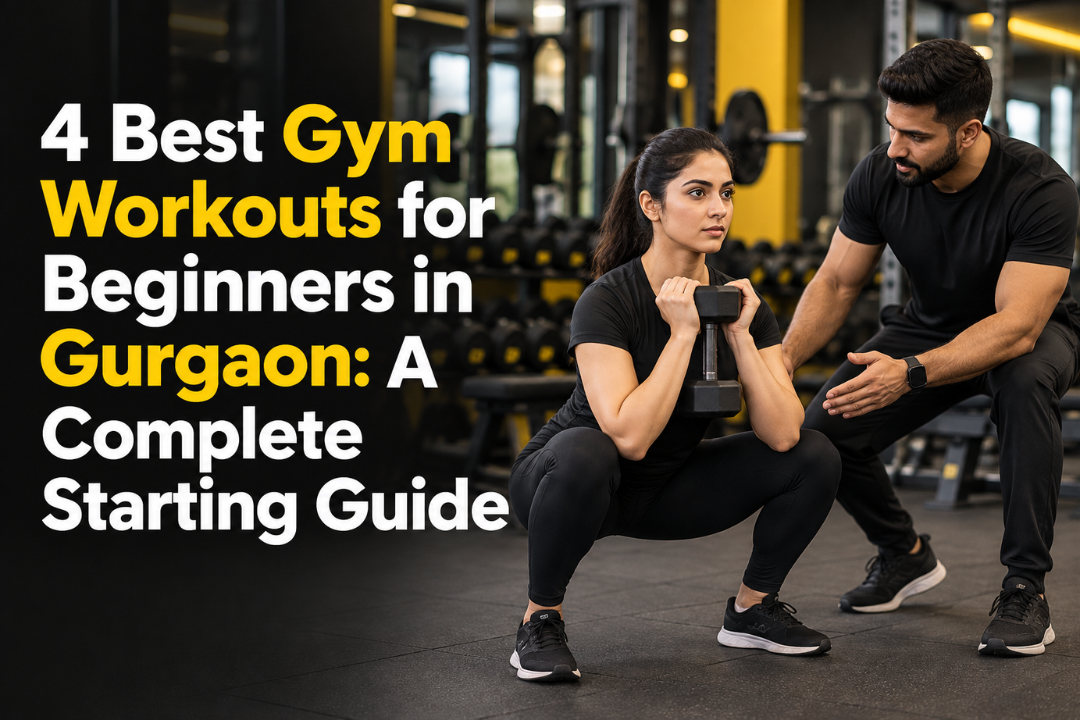
Starting at a gym should not mean copying the strongest person in the room, training seven days a week or trying every machine before you understand what it does.
For most beginners, the first month has a much simpler job.
Learn a few basic movements. Train your whole body consistently. Use weights you can control. Add cardio gradually. Recover properly. Then repeat the process long enough for your body and confidence to adapt.
If you are looking for a beginner gym in Gurgaon, especially around Sector 49, Sohna Road, Vatika City or Orchid Petals, your first priority should not be finding the most advanced workout. It should be finding a routine you can actually follow around work, traffic, family commitments and your current fitness level.
That fits closely with the broader philosophy at 300 Fitness: make fitness easier to follow and build consistency rather than depending on random extreme workouts.
What is the best gym workout for a beginner?
A good beginner workout usually focuses on the whole body two or three times per week, basic pushing, pulling and lower body movements, manageable resistance, controlled technique and gradual progression. Add easy to moderate cardio around your strength sessions and leave enough recovery between harder workouts. In the first month, consistency and good form matter more than lifting heavy weights or following an advanced bodybuilding split.
What Beginners Should Focus on in the First Month
Your first month is not a test of how much discomfort you can tolerate.
It is a learning phase.
You are learning what different exercises feel like, how gym equipment works, how much effort you can recover from and how to organise training around normal life.
A useful first month should help you build five things:
- A repeatable weekly schedule.
- Basic exercise technique.
- Familiarity with common gym equipment.
- Confidence with strength and cardio training.
- A simple way to track progress.
Many beginners make the mistake of measuring the quality of a workout by soreness.
Soreness is not a workout score.
You can have a productive session without struggling to walk the next morning. In fact, making yourself excessively sore in week one can make your next workout harder to complete.
Current physical activity guidance recommends that people who have been inactive start with smaller amounts of activity and build up over time rather than jumping immediately to a high training volume.
What Should You Do on Your First Day at the Gym?
Your first day should be intentionally simple.
Do not try to complete a bodybuilding split you found online.
Spend the session learning the environment.
A practical first visit may include:
- 5 to 10 minutes of comfortable walking or cycling;
- a simple lower body exercise;
- one pushing exercise;
- one pulling exercise;
- one or two additional basic movements;
- a short period of easy cardio if you feel comfortable.
The exact exercises can depend on the equipment available and your movement ability.
For example, a beginner may find a machine chest press easier to learn initially than a barbell bench press. A leg press or supported squat variation may feel more approachable than loading a barbell on day one.
Neither option makes you more or less serious.
Your goal is to learn movements you can repeat with control.
If you are unsure about equipment setup or technique, ask a trainer before adding resistance.
A Simple Full Body Workout Structure for Beginners
A beginner does not necessarily need a separate chest day, back day, arm day and leg day.
A simple full body approach allows you to practise the main movement patterns regularly without needing to live in the gym.
The CDC’s current physical activity guidance recommends muscle strengthening activity on at least two days each week, involving the major muscle groups. It also notes that strength exercises can use weights, machines, resistance bands or body weight.
Here is a practical example for a generally healthy beginner.
Beginner Full Body Workout A
| Exercise Pattern | Example Exercise | Starting Structure |
| Lower body | Leg press or goblet squat | 1 to 2 sets of 8 to 12 reps |
| Horizontal push | Machine chest press | 1 to 2 sets of 8 to 12 reps |
| Vertical pull | Lat pulldown | 1 to 2 sets of 8 to 12 reps |
| Posterior chain | Seated leg curl or coached hip hinge | 1 to 2 sets of 8 to 12 reps |
| Horizontal pull | Seated cable row | 1 to 2 sets of 8 to 12 reps |
| Core | Plank or another controlled core exercise | 1 to 2 controlled sets |
Beginner Full Body Workout B
| Exercise Pattern | Example Exercise | Starting Structure |
| Lower body | Supported split squat or leg press variation | 1 to 2 sets of 8 to 12 reps |
| Upper body push | Dumbbell or machine press | 1 to 2 sets of 8 to 12 reps |
| Upper body pull | Cable row or pulldown variation | 1 to 2 sets of 8 to 12 reps |
| Hip dominant movement | Glute bridge or coached hinge | 1 to 2 sets of 8 to 12 reps |
| Shoulder movement | Light machine or dumbbell press | 1 to 2 sets of 8 to 12 reps |
| Core | Dead bug or another controlled core exercise | 1 to 2 controlled sets |
This is an example, not an individual prescription.
Exercise choice should be adjusted for your current ability, equipment access and any relevant health or movement considerations.
The CDC notes that 8 to 12 repetitions can count as a set for muscle strengthening, and that people may begin with at least one set before increasing the amount as appropriate.
A Simple Three Day Beginner Gym Schedule
If your schedule allows three gym visits, you could structure the week like this:
| Day | Training |
| Monday | Full Body Workout A |
| Tuesday | Rest, walking or easy activity |
| Wednesday | Full Body Workout B |
| Thursday | Rest or easy activity |
| Friday | Full Body Workout A |
| Saturday | Optional walking, easy cardio or mobility |
| Sunday | Rest |
The following week, begin with Workout B.
That allows both routines to appear equally over time.
If three gym days do not fit your schedule, start with two.
Two sessions you consistently complete are more useful than a five day program you abandon after ten days.
How Hard Should a Beginner Train?
Choose resistance you can control.
That sounds obvious, but beginners are often tempted to choose weights based on what other people are lifting.
The weight should allow you to complete the planned repetitions without losing control of the movement.
You should not need to turn every set into a maximum effort.
A simple beginner rule is:
Finish the set while your technique still looks like the technique you started with.
If your position changes dramatically, you are using momentum to complete repetitions or the movement becomes uncomfortable, stop and reassess before adding more weight.
Your trainer can help determine an appropriate starting resistance and exercise variation.
Learning Correct Form Before Adding Weight
This is one of the most important habits you can build.
More resistance does not automatically mean better training.
If adding weight changes the movement completely, you have progressed the number on the machine without necessarily progressing the exercise.
For a beginner, good form generally means:
- the movement is controlled;
- the intended range of motion is appropriate for you;
- your body position remains reasonably stable;
- you can repeat the movement consistently;
- the resistance does not force you to rush.
You do not need perfect textbook form before making any progress.
Bodies differ.
But you do need enough control to make progression sensible.
The 300 Fitness Workout Analysis also emphasises balancing training challenge with recovery and using structured progression instead of simply doing more work.
New to the Gym and Not Sure Where to Start?
Visit 300 Fitness in Sector 49, Sohna Road and discuss a training structure that matches your current fitness level and weekly routine.
How Much Cardio Should a Beginner Do?
Cardio does not need to dominate your first month.
For a beginner, the sensible approach is to build it gradually.
Walking, cycling, an elliptical trainer or another activity you can perform comfortably can all contribute to aerobic activity.
Your cardio could begin with shorter sessions and increase as your fitness improves.
For example, you may add 10 to 20 minutes of easy or moderate cardio after selected strength sessions, or complete a separate walking or cardio session on another day.
The exact amount should depend on your current activity level.
The World Health Organization recommends that adults work towards 150 to 300 minutes of moderate intensity aerobic activity per week, or the equivalent amount of vigorous activity, together with muscle strengthening activity on two or more days.
You can read the official WHO India physical activity guidance.
You do not need to achieve the upper end of that range in your first week.
If you are currently inactive, building towards it gradually is far more practical.
Should Beginners Do Cardio or Weights First?
If your main purpose for the session is learning strength exercises, doing the strength portion while you are relatively fresh can make sense.
If you are attending specifically for cardio, then cardio is obviously the main session.
There is no rule that every beginner must organise every workout identically.
For a basic combined gym session, a practical order might be:
- Short general warm up.
- Strength training.
- Optional easy or moderate cardio.
- Finish the session and recover.
Avoid turning the warm up into a tiring cardio workout before you have even started learning your strength exercises.
How Long Should a Beginner Workout Last?
Longer is not automatically better.
A focused beginner session can often be completed in roughly 45 to 60 minutes, depending on the exercises, rest periods and whether cardio is included.
If you need 90 minutes because you are carefully learning equipment during the first few visits, that is not a problem.
If you need 90 minutes because you are performing fifteen exercises for no clear reason, simplify the program.
The first month should teach you to train with purpose.
It should not teach you that a gym visit must consume your entire evening.
That matters in Gurgaon.
If you work around Sohna Road or travel through Sector 49 after office hours, your commute can already create friction. A routine that requires unrealistic amounts of gym time may be harder to sustain.
How to Progress During Your First Four Weeks
Progress does not mean adding weight every workout regardless of technique.
Use a calmer progression model.
Week 1: Learn
Focus on:
- equipment setup;
- controlled movement;
- remembering the exercises;
- understanding how the session flows.
Week 2: Repeat
Keep most of the exercises the same.
You need repetition to improve your technique.
Changing every exercise because you are bored after one week defeats the purpose.
Week 3: Add Repetitions Where Appropriate
If you performed 8 controlled repetitions last week and can now comfortably perform 9 or 10, that is progress.
You do not always need heavier weights.
Week 4: Consider a Small Resistance Increase
If you can complete the upper end of your planned repetition range with consistent technique, a small increase may be appropriate.
Then return towards the lower end of the repetition range and build again.
This keeps progression measurable without turning every session into a strength test.
Rest Days and Recovery for New Members
Rest is part of the program.
You do not become less committed because you are not training every day.
Beginners are adapting to a new workload.
Spacing harder strength sessions across the week gives you time to recover before training the same major muscle groups again.
On non gym days, you can still be active.
Walking, easy mobility work or other comfortable activity can fit well between strength sessions.
The current U.S. Physical Activity Guidelines also advise people to increase activity gradually, noting that large jumps between someone’s normal activity level and a new workload can increase the risk of musculoskeletal injury.
If you have a chronic health condition, significant pain, a recent injury or another medical concern, get appropriate professional guidance before following a generic training template.
Beginner Gym Checklist for the First Month
Your First Month Checklist
If these basics are improving, your beginner program is moving in the right direction.
Common Beginner Gym Mistakes
Doing Too Much Too Soon
Five or six hard workouts in your first week may feel productive.
It often creates a routine that your current lifestyle and recovery cannot support.
Start with a volume you can repeat.
Copying Advanced Lifters
Someone who has trained for eight years has different needs from someone in week one.
Their exercise selection, weekly volume and training intensity may have very little relevance to your starting point.
Changing the Workout Every Session
Variety can be enjoyable, but constant novelty makes it difficult to learn technique or track progress.
Repeat important movements long enough to improve them.
Lifting for Ego
The gym is not an exam.
Nobody awards points because you selected the heaviest dumbbells.
The useful weight is the weight you can train with productively.
Ignoring Recovery
Harder training requires recovery.
Sleep, food, hydration and a sensible schedule all influence how ready you feel for the next session.
Treating Cardio as Punishment
Cardio is training, not punishment for what you ate.
Choose an intensity and activity you can build consistently.
Expecting a Transformation in Two Weeks
Your first month should build a system.
If you spend it chasing rapid visual changes, you may overlook progress in strength, confidence, stamina and consistency.
Do Beginners Need a Personal Trainer?
Not every beginner needs dedicated personal training.
Some people are comfortable learning with basic gym orientation, a structured workout plan and occasional trainer guidance.
Personal training may be useful if you:
- do not know how to perform the exercises;
- feel uncomfortable using gym equipment;
- want closer technique feedback;
- need more accountability;
- have a specific goal;
- struggle to organise your own training.
The important question is not whether everyone should hire a trainer.
Ask:
Would individual coaching solve a problem that is currently stopping me from training well?
If yes, it may be worth considering.
You can learn more about the broader 300 Fitness approach or discuss your starting point directly with the team.
How the 300 Minutes Per Week Idea Fits a Beginner Routine
The #300MinutesPerWeek concept should not be interpreted as 300 minutes of hard gym training.
Weekly movement can include different forms of activity.
A beginner’s week may eventually include:
- two or three strength workouts;
- walking;
- moderate cardio;
- mobility work;
- group exercise;
- other activities you enjoy.
WHO guidance places 300 minutes at the upper end of its recommended weekly moderate aerobic activity range for adults, while also recommending muscle strengthening on at least two days.
For someone who currently does very little exercise, the first goal is not to jump directly to the maximum.
Build towards a more active week.
That is a much more useful interpretation.
Choosing a Beginner Gym in Gurgaon
A beginner friendly gym is not simply a gym with lighter dumbbells.
Look for a place where you can comfortably learn.
When visiting a gym in Sector 49 Gurgaon or elsewhere nearby, check:
- Are trainers approachable?
- Can someone explain equipment setup?
- Is there a clear starting process?
- Can you train comfortably at your usual time?
- Does the environment feel intimidating or supportive?
- Is your workout structured?
- Can you ask questions without feeling awkward?
Location also matters.
If you live around Vatika City or Orchid Petals and work elsewhere in Gurgaon, consider the route you will actually take on training days.
A perfect workout program cannot compensate for a gym you rarely reach.
Consistency is partly a training decision and partly a logistics decision.
Is 300 Fitness Suitable for Someone Starting Out?
300 Fitness is located in Sector 49 on Sohna Road, Gurgaon, which can make it a practical option for people living or working around the surrounding residential and commercial areas.
The brand’s core approach is based on making fitness easier to follow, building consistent weekly activity and using more structured training instead of relying on random workouts.
That approach is particularly relevant to beginners because the biggest problem in month one is often not effort.
It is confusion.
If you are unsure whether you need a basic membership, more structured guidance or personal training, discuss that before you commit.
A good starting plan should match where you are now, not where you think you should already be.
Start With a Workout You Can Actually Repeat
Visit 300 Fitness at Sector 49, Sohna Road and discuss a beginner training structure built around your current fitness level, schedule and goals.
Visit 300 FitnessFrequently Asked Questions
How many days should a beginner go to the gym?
Two to three strength training days per week can be a practical starting structure for many generally healthy beginners. The right frequency depends on your current activity level, recovery and schedule. More days are not automatically better if you cannot recover or maintain the routine.
What should I do on my first day at the gym?
Keep your first session simple. Learn the gym layout, warm up, practise a few basic lower body, pushing and pulling movements with manageable resistance, and ask a trainer to explain unfamiliar equipment. Your first day should build confidence rather than exhaust you.
Should beginners do cardio or weights first?
If the main goal of the session is strength training, doing the strength exercises while relatively fresh can be practical, followed by optional easy or moderate cardio. A short warm up can still come first. The order should reflect the main purpose of the session.
How long should a beginner gym workout last?
Many beginners can complete a useful workout in around 45 to 60 minutes, although the exact duration varies. Training quality matters more than staying in the gym for a specific amount of time.
Do beginners need a personal trainer?
Not every beginner needs personal training. It may be useful if you need individual help with technique, equipment, workout structure, progression or accountability. Beginners who are confident following a suitable plan may need only occasional trainer guidance.
Should beginners lift heavy weights?
Beginners should first use resistance they can control with appropriate technique. Weight can gradually increase as movement quality and strength improve. Lifting heavier simply to match another gym member is not a useful progression strategy.
Is full body training good for beginners?
A full body program can work well for beginners because it allows major movement patterns and muscle groups to be trained multiple times across the week without requiring a complicated body part split.
How much cardio should a beginner do?
Cardio should be built gradually according to your starting fitness level. Walking, cycling and other manageable aerobic activities can be added around strength training. Adults can progressively work towards established physical activity guidelines rather than trying to complete the full weekly target immediately.
How quickly should beginners increase gym weights?
Increase resistance only when you can complete your current workload with controlled technique. You can also progress by improving form or adding repetitions before increasing the load.
Where can beginners join a gym in Sector 49 Gurgaon?
300 Fitness is located in Sector 49 on Sohna Road, Gurgaon. Beginners can contact the team through the official 300 Fitness contact page to discuss their fitness level, goals and the type of training support they may need.