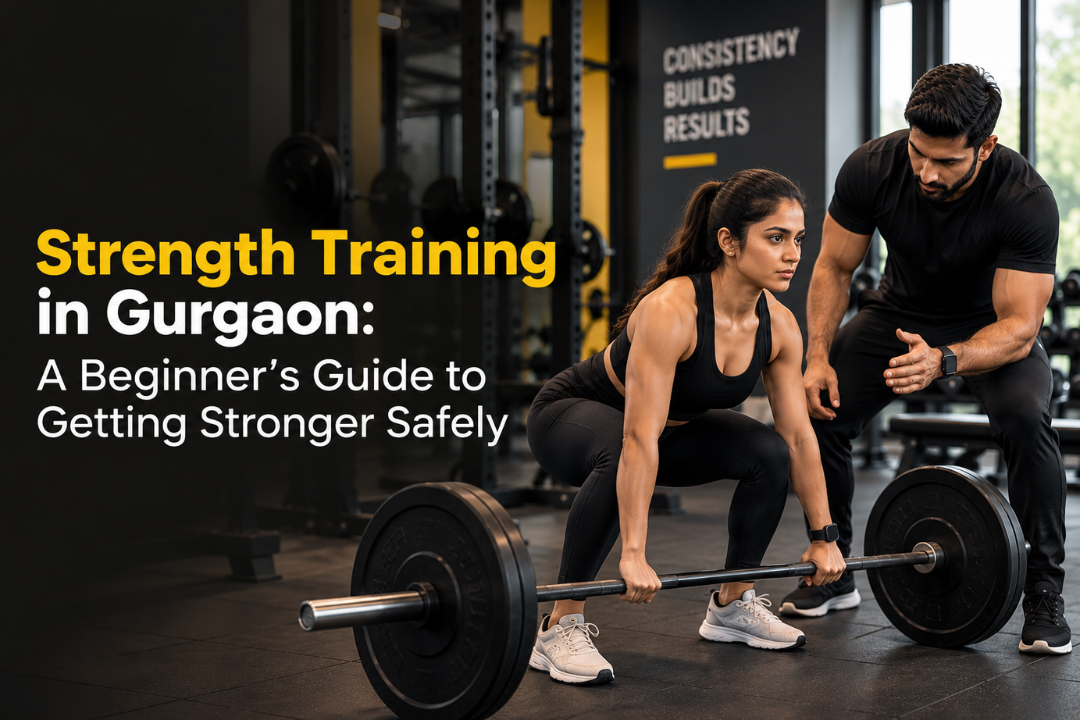
Strength training does not mean walking into a gym and trying to lift the heaviest weight you can manage.
For a beginner, good strength training is much simpler. Learn the main movement patterns, choose resistance you can control, repeat those exercises consistently and gradually make them more challenging as your technique and strength improve.
If you are looking for strength training in Gurgaon, especially around Sector 49, Sohna Road, Rosewood City or Tatvam Villas, the program you can follow consistently will usually matter more than the most complicated workout you can find online.
That idea is strongly supported by the latest evidence. The American College of Sports Medicine updated its resistance training guidelines in 2026 after reviewing 137 systematic reviews representing more than 30,000 participants. One of its clearest conclusions was that consistency matters more than complicated programming for most healthy adults.
How should a beginner start strength training?
Start with two or three structured sessions per week and learn basic squat, hinge, push and pull movements with resistance you can control. Track your repetitions and weights, then increase the challenge gradually as your technique improves. Beginners do not need advanced programs, maximum lifts or dozens of exercises. Consistent training, sensible progression and enough recovery are the foundation.
What Is Strength Training?
Strength training is exercise in which your muscles work against resistance.
That resistance can come from:
- dumbbells;
- barbells;
- weight machines;
- cable machines;
- resistance bands;
- kettlebells;
- body weight;
- other appropriately loaded movements.
The purpose is to create enough muscular demand that your body gradually adapts.
Those adaptations can include improvements in strength, muscle function, muscular endurance and physical performance.
The 2026 ACSM Position Stand found that resistance training significantly improved strength, muscle size, power, endurance, balance and several measures of physical function compared with not performing resistance training.
You also do not need one particular type of equipment to become stronger. ACSM notes that body weight exercises, elastic bands and home based resistance training can also produce meaningful benefits.
A gym simply gives you a wider range of ways to apply and progress resistance.
Strength Training vs Weight Training vs Resistance Training
These terms are often used interchangeably, but there are small differences.
Resistance training is the broadest term. It means exercising your muscles against resistance.
Weight training normally refers to resistance created by dumbbells, barbells, machines or other external weights.
Strength training describes training where improving muscular strength is an important goal.
In a normal gym conversation, the differences are rarely worth overcomplicating.
If you are increasing your ability to perform movements against resistance over time, you are doing some form of resistance or strength training.
Strength Training vs Bodybuilding: Are They the Same?
Not exactly.
Both use resistance exercise, but the primary goals can differ.
| Strength Training | Bodybuilding |
| Primary focus is increasing strength and physical capability | Primary focus is usually muscular development and physique |
| Performance on important movements is often tracked | Muscle size, proportion and appearance receive more emphasis |
| Programs may prioritise heavier resistance for key movements | Programs often use more total volume for specific muscle groups |
| Can use free weights, machines, bands or body weight | Also uses many of the same tools |
There is plenty of overlap.
A person training primarily for strength can still gain muscle.
A person training primarily for muscle growth can also become stronger.
The difference is mainly how the training variables are prioritised.
ACSM’s 2026 guidance reflects this distinction. It found that heavier loads can optimise strength development, while higher weekly training volume plays a larger role when muscle hypertrophy is the main goal.
For a complete beginner, however, the first objective should not be debating advanced strength versus hypertrophy programming.
Learn to train first.
Essential Movement Patterns for Beginners
You do not need thirty exercises.
Start by understanding a few basic movement categories.
1. Squat Pattern
Squatting involves bending through the hips and knees while controlling your body against resistance.
Beginner options may include:
- body weight squat;
- supported squat;
- goblet squat;
- leg press;
- other coached squat variations.
The exact exercise matters less than choosing one you can perform with reasonable control.
2. Hip Hinge Pattern
A hinge involves loading the hips and posterior chain.
Examples can include:
- hip hinge drills;
- Romanian deadlift variations;
- kettlebell deadlift;
- conventional deadlift variations;
- cable pull through;
- hip extension exercises.
The hinge can take time to learn.
There is no reason to rush directly into a heavy barbell deadlift because somebody told you it is compulsory.
3. Push Pattern
A push involves moving resistance away from your body.
Examples include:
- machine chest press;
- dumbbell press;
- push ups;
- overhead press;
- cable presses.
4. Pull Pattern
A pull involves bringing resistance towards your body.
Examples include:
- seated cable rows;
- dumbbell rows;
- lat pulldowns;
- assisted pull ups;
- machine rows.
5. Core and Bracing
Core training is not limited to crunches.
Beginners should learn to control their trunk while moving and resisting load.
Exercises may include:
- planks;
- dead bugs;
- carries;
- controlled cable exercises;
- other stability movements.
A beginner strength program built around these basic patterns can cover a large part of what you actually need.
A Simple Beginner Strength Training Workout
Here is an example structure for a generally healthy beginner.
It is not an individual medical or exercise prescription.
| Movement | Example | Starting Structure |
| Squat | Goblet squat or leg press | 2 sets of 8 to 12 reps |
| Push | Machine chest press | 2 sets of 8 to 12 reps |
| Pull | Lat pulldown | 2 sets of 8 to 12 reps |
| Hinge | Light Romanian deadlift or coached hinge | 2 sets of 8 to 12 reps |
| Pull | Seated cable row | 2 sets of 8 to 12 reps |
| Core | Plank or dead bug | 2 controlled sets |
The resistance should feel challenging enough that the exercise requires effort but manageable enough that you remain in control.
You do not need to reach complete muscular failure on every set.
In fact, ACSM’s 2026 review found that training to momentary muscle failure was not consistently necessary for improving outcomes in the average healthy adult.
Form Before Load
One of the fastest ways to turn strength training into ego lifting is to measure every workout only by the amount of weight on the machine or bar.
More weight is useful only when you can manage it appropriately.
Before increasing resistance, ask:
- Can I control the movement?
- Is my technique reasonably consistent?
- Can I complete the intended repetitions?
- Am I using momentum simply to finish the set?
- Has my range of motion dramatically changed?
- Am I actually ready for more resistance?
Better control at the same weight can represent progress.
More repetitions with good technique can represent progress.
A slightly larger range of motion can represent progress.
You do not need a personal record every Monday.
300 Fitness’s own Workout Analysis guide also emphasises finding a balance between sufficient training stimulus and recovery, rather than simply doing as much work as possible.
What Is Progressive Overload?
Progressive overload means gradually increasing the training challenge as your body becomes capable of handling more.
This is one of the fundamental ideas behind getting stronger.
It does not mean adding weight every session regardless of technique.
Progression can happen through several methods:
- More resistance.
- More repetitions.
- Additional productive sets.
- Better movement control.
- Greater appropriate range of motion.
- A more challenging exercise variation.
Consider a simple dumbbell press programmed for 8 to 12 repetitions.
Week 1:
10 kg for 8 reps.
Later:
10 kg for 10 reps.
Later:
10 kg for 12 controlled reps.
Once the upper end becomes manageable with good technique, you might move to the next sensible resistance and begin closer to 8 repetitions again.
That is structured progression.
It is very different from randomly choosing a heavier dumbbell because your workout partner did.
New to Strength Training?
Visit 300 Fitness in Sector 49, Sohna Road and discuss how to start with a structured resistance training plan that matches your current fitness level.
A Simple Progressive Overload Example
Progress Without Ego Lifting
Use progression as a process, not as a challenge to beat someone else’s numbers.
How Often Should Beginners Strength Train?
For many beginners, two or three strength sessions per week is a practical starting point.
WHO recommends that adults perform muscle strengthening activities involving major muscle groups on at least two days each week.
ACSM’s updated evidence review similarly identifies training major muscle groups at least twice weekly as a strong general foundation.
That does not mean you need to perform exactly two workouts forever.
It means you do not need six bodybuilding days to begin.
Example Two Day Schedule
Monday: Full body strength
Thursday: Full body strength
Other days can include walking, cardio, mobility, classes or normal daily activity.
Example Three Day Schedule
Monday: Full body A
Wednesday: Full body B
Friday: Full body A
The following week can begin with Workout B.
This lets you practise movements regularly while still having recovery time.
Should You Strength Train Every Day?
Beginners generally do not need to perform demanding full body resistance training every day.
Training creates a stimulus.
Recovery is where your body adapts to that stimulus.
If your performance continuously declines, your muscles remain excessively sore or every workout feels worse than the previous one, adding another hard session may not be the solution.
A rest day does not mean you must remain completely inactive.
Walking or comfortable mobility work may fit well between strength sessions.
How Strength Training Fits #300MinutesPerWeek
The 300 Fitness philosophy includes #300MinutesPerWeek, but those 300 minutes should not be interpreted as 300 minutes of heavy lifting.
Weekly activity can contain several components.
For example:
| Activity | Example Weekly Amount |
| Strength training | 3 × 50 minutes |
| Walking or moderate cardio | 3 × 30 minutes |
| Group workout, mobility or additional activity | 60 minutes |
| Total | 300 minutes |
This is simply an illustration.
The appropriate mix depends on your goals and current fitness.
WHO recommends 150 to 300 minutes of moderate intensity aerobic activity per week for adults, together with muscle strengthening activities on two or more days.
Strength training is therefore part of a balanced activity week, not a replacement for every other type of movement.
Can Strength Training Support Fat Loss?
Yes, resistance training can be an important part of a fat loss program.
But it should not be sold as a magic fat burning method.
Fat loss depends on overall energy balance across time, while training helps maintain and develop physical capacity and muscle.
The CDC notes that physical activity contributes to energy expenditure, while weight loss generally requires an energy deficit. Adults are also advised to include muscle strengthening alongside aerobic activity.
A balanced fat loss routine may therefore include:
- resistance training;
- cardio;
- daily movement;
- appropriate nutrition;
- recovery;
- consistency.
Do not choose between strength and cardio as if one must completely replace the other.
Do You Need Free Weights to Build Strength?
No.
This is one of the easiest beginner myths to remove.
Machines can build strength.
Dumbbells can build strength.
Barbells can build strength.
Resistance bands can build strength.
Body weight exercises can build strength.
ACSM’s updated review found that equipment type did not consistently determine outcomes for the average healthy adult.
Each tool has advantages.
Machines may be easier for some beginners to learn.
Free weights can introduce additional coordination and stabilisation demands.
Bands can be convenient.
Body weight movements can be accessible almost anywhere.
The best choice is the one that fits the exercise, your current ability and your program.
Common Strength Training Mistakes Beginners Make
Adding Weight Too Quickly
If technique deteriorates every time the load increases, the progression is too aggressive.
Copying Someone Else’s Program
A routine designed for an experienced lifter does not become a beginner program because you use lighter weights.
Your training should match your experience.
Changing Exercises Every Week
Progress is difficult to measure when the workout constantly changes.
Repeat important movements long enough to improve them.
Doing Too Many Exercises
More variety is not necessarily more productive.
A few well selected exercises performed consistently can be enough to build a strong beginner foundation.
Ignoring Lower Body Training
Strength training should not become chest, arms and shoulders five times per week.
Train the major muscle groups.
Treating Soreness as Progress
Soreness tells you that your body experienced a stimulus it was not fully accustomed to.
It does not tell you whether your program is well designed.
Skipping Workout Tracking
If you do not know what resistance or repetitions you performed last time, progressive overload becomes guesswork.
Lifting Through Pain
Hard muscular effort and sharp or unusual pain are not the same thing.
Stop and get appropriate guidance when something feels wrong.
People with existing health conditions, injuries or significant pain should seek individual medical or rehabilitation guidance rather than following a generic internet program.
Strength Training in Gurgaon: Why Location Still Matters
A good program is useful only if you consistently perform it.
If you live around Rosewood City or Tatvam Villas and train near Sector 49 or Sohna Road, think about how the gym fits into your actual week.
Ask:
- Can I reach it after work?
- What is the commute like at my normal training time?
- Can I realistically train there two or three times every week?
- Is the strength equipment available during my preferred hours?
- Can I get help when learning unfamiliar exercises?
Gurgaon traffic can turn a theoretically convenient workout into a difficult habit if the location does not fit your route.
Consistency is partly about motivation.
It is also about logistics.
What Should You Look for in a Strength Training Gym in Gurgaon?
Do not judge a strength training facility only by how many plates are visible in the photographs.
Look for:
- appropriate free weights and resistance equipment;
- enough variety to train major movement patterns;
- trainer availability for equipment guidance;
- a structured approach to progression;
- room to train safely;
- an environment comfortable for your experience level;
- a location you can actually use consistently.
The current 300 Fitness website lists strength training among its workout formats and says members have access to personalised workout cards, fitness assessments and trainer guidance on equipment use.
You can explore the broader 300 Fitness services and the brand’s fitness approach before deciding whether it matches the type of training you want.
Is Personal Training Necessary for Strength Training?
No.
Many people can strength train successfully without one to one coaching.
Personal training may become useful when you:
- are completely new to resistance exercise;
- need help learning technique;
- do not know how to build progression;
- lack confidence with equipment;
- keep changing your program;
- want individual accountability;
- have a specific performance goal.
A trainer should make the program easier to understand, not make strength training look unnecessarily complicated.
The goal should eventually be that you understand why an exercise is in your program, what you are trying to improve and how progress is measured.
Is 300 Fitness Suitable for Strength Training Beginners?
300 Fitness is based around Sector 49 on Sohna Road in Gurgaon.
Its current website positions the gym around making fitness easier for members and lists personalised workout cards, fitness assessment, trainer guidance and strength training among its current fitness offering.
For a beginner, that structure can matter.
You should know:
What am I training?
Why am I doing this exercise?
How much should I do?
When should I increase it?
How will I know I am improving?
Those questions matter more than how intimidating your workout looks.
Build Strength With a Plan You Can Progress
Visit 300 Fitness at Sector 49, Sohna Road and discuss a structured strength training approach based on your current experience, weekly schedule and fitness goals.
Schedule a VisitFrequently Asked Questions
How many days a week should I strength train?
For many beginners, two or three strength training sessions per week can be a practical starting point. WHO recommends muscle strengthening activity involving major muscle groups on at least two days each week. Your exact schedule should reflect your experience, recovery and goals.
Is strength training good for beginners?
Yes. Beginners can perform strength training using appropriate resistance, sensible exercise selection and gradual progression. The first priority should be learning technique and building consistency rather than immediately lifting very heavy weights.
Can strength training support fat loss?
Strength training can form part of a fat loss program by helping maintain and develop muscle and physical capacity. Fat loss still depends on overall energy balance, so training should normally be combined with appropriate nutrition and overall activity.
What is progressive overload?
Progressive overload is the gradual increase in training demand as you become stronger or more capable. It can involve adding resistance, repetitions, productive sets, exercise difficulty or improving movement quality.
Do I need free weights to build strength?
No. Strength can be developed using machines, free weights, resistance bands and body weight exercises. The right equipment depends on the exercise, your experience and your training goal.
Is strength training the same as bodybuilding?
No. Both use resistance exercise, but strength training mainly prioritises increasing force and physical capability, while bodybuilding places greater emphasis on muscle development and physique. Their programs can still overlap significantly.
Should beginners lift heavy weights?
Beginners should use resistance they can control while learning proper movement patterns. Heavier loading can become appropriate as technique and strength improve, but there is no reason to rush into maximal or near maximal lifting.
How quickly should I increase weight in the gym?
There is no universal timetable. Increase resistance when you can consistently complete your planned repetitions with appropriate control and the next weight increment is manageable. Progress can also happen through additional repetitions before adding weight.
Can I strength train every day?
You do not need hard full body strength sessions every day to improve. Beginners usually benefit from recovery between demanding sessions. The weekly schedule should balance training stimulus with enough recovery to perform well again.
Where can I start strength training in Sector 49 Gurgaon?
300 Fitness is located around Sector 49, Sohna Road, Gurgaon. You can use the official 300 Fitness contact page to discuss your current fitness level and the type of strength training support you may need.