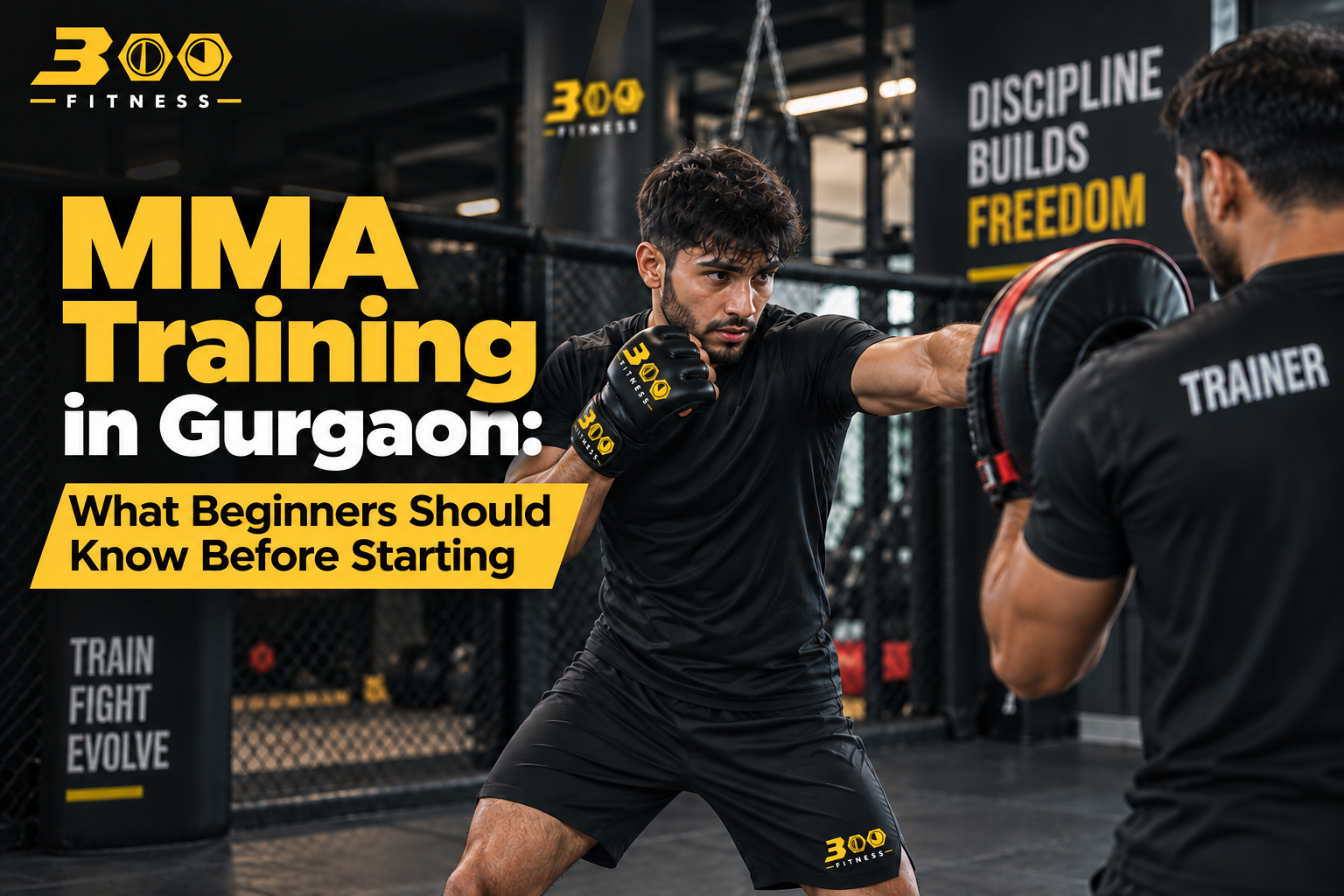
A complete beginner can start MMA training without previous martial arts experience or competition ambitions. Beginner training should first teach fundamental striking, movement and grappling skills through controlled drills, while conditioning develops gradually. Hard sparring should not be treated as a day-one requirement.
That distinction is important if you are searching for MMA training in Gurgaon mainly because you want a more engaging way to improve fitness, learn a skill and build conditioning.
Mixed Martial Arts can look intimidating from the outside because most people first see it through professional fights. A normal beginner class should look very different from a competitive bout.
If you live or work around Sector 49, Sohna Road, Central Park Resorts or Vipul Greens, look for a training structure that teaches fundamentals before intensity and fits realistically into your weekly routine.
Can complete beginners start MMA training?
Yes. Beginner MMA should start with basic stance, footwork, striking, grappling positions and controlled partner drills. You do not need to compete or hard spar to use MMA for fitness. Look for coaching that separates learning from fighting, adjusts drills to your experience level and gradually develops conditioning rather than expecting advanced intensity immediately.
What Is MMA Training?
MMA stands for Mixed Martial Arts.
It combines striking and grappling rather than limiting training to one combat discipline.
The International Mixed Martial Arts Federation describes MMA as a synthesis of striking, grappling and tactical combat. Its rules recognise both effective striking and effective grappling as central parts of the sport.
In practical training, MMA may draw techniques from disciplines such as:
- boxing;
- kickboxing;
- Muay Thai;
- wrestling;
- Brazilian Jiu-Jitsu;
- other grappling systems.
You do not need to master each martial art separately before starting.
A beginner program should introduce the pieces in a manageable sequence.
Striking
Striking training can involve:
- stance;
- guard;
- punches;
- kicks;
- basic defence;
- distance management;
- footwork.
Grappling
Grappling can involve:
- takedown fundamentals;
- clinch positions;
- controlling positions;
- escapes;
- ground movement;
- basic submission concepts.
Conditioning
MMA also creates significant physical demands because participants repeatedly move between striking, grappling and changes in position.
Sport science reviews describe MMA performance as involving a complex mix of strength, power, anaerobic capacity and aerobic fitness. These studies largely concern competitive athletes, so they should not be used to predict an exact fitness outcome for a recreational beginner.
The useful takeaway for a beginner is simpler:
MMA is both a skill and a physical workout.
What Beginners Typically Learn First
Your first few weeks should not revolve around memorising fifty techniques.
The basics matter more.
Stance and Movement
Before you punch or attempt a takedown, you need to learn how to move without constantly losing your balance.
Early sessions may cover:
- basic stance;
- moving forward and backward;
- lateral movement;
- guard position;
- basic distance management.
Simple Striking
You may then learn straightforward striking combinations.
For example:
- jab;
- cross;
- basic hooks;
- simple kicks;
- basic defensive movements.
The objective should initially be coordination and technique, not maximum power.
Basic Grappling Positions
A beginner may be introduced to positions such as:
- standing clinch;
- basic takedown positions;
- guard;
- side control;
- mount;
- simple escapes.
The terminology may feel unfamiliar at first.
That is normal.
Controlled Drilling
Drilling means repeating a specific movement or sequence with a partner so both people can learn.
For example, one person may practise a takedown entry while the other provides controlled cooperation.
This is very different from trying to beat your training partner.
IMMAF’s guidance for beginners emphasises fundamental skills and gradually developing participants rather than relying on physical dominance.
Read IMMAF participant pathway guidance
Technique, Movement and Conditioning
MMA conditioning should support technique.
It should not replace technique.
This matters because beginners often assume the hardest class is automatically the best class.
It is easy to create exhaustion.
Good training has a clearer purpose.
You might practise:
- shadowboxing;
- pad combinations;
- sprawls;
- controlled takedown entries;
- grappling transitions;
- short conditioning rounds;
- bodyweight movements;
- basic resistance exercises.
The technical work teaches you what to do.
Conditioning helps you continue doing it effectively as fatigue builds.
Why Conditioning Should Progress Gradually
A complete beginner is already dealing with a new training stimulus.
Your shoulders may tire from holding your guard.
Your legs may tire from stance and movement.
Grappling positions may create unfamiliar muscular demands.
Adding a large amount of separate high intensity conditioning immediately may simply create more fatigue.
Build capacity gradually.
The 300 Fitness Fit School also frames workout planning around balancing insufficient training, excessive training and an appropriate training stimulus rather than assuming more work always creates better progress.
Explore 300 Fitness Fit School
Do You Need to Get Fit Before Starting MMA?
No.
You do not need to reach some imaginary fitness standard before attending a beginner session.
You become fitter partly by training.
That said, a responsible beginner program should allow your workload to scale.
Someone who already runs and strength trains may tolerate more conditioning than someone returning to exercise after several inactive years.
Both can still begin.
Your starting point should influence the amount of work, not whether you are allowed to learn.
For general health, WHO recommends regular aerobic activity and muscle-strengthening activity across the week, while also emphasising that some activity is better than none.
WHO physical activity guidance
Interested in MMA or Combat-Focused Fitness?
Visit 300 Fitness in Sector 49, Sohna Road and discuss your current fitness level, training goals and available structured workout options.
MMA Fitness vs Competitive MMA
This distinction should be clear before you join.
You can enjoy MMA-inspired or technical training without preparing to enter a fight.
Fitness-Focused MMA
The goal may be:
- improving fitness;
- learning movement;
- practising technique;
- building coordination;
- adding conditioning;
- making exercise more engaging.
Sessions can use:
- shadowboxing;
- pads;
- bags;
- non-contact striking drills;
- controlled grappling drills;
- strength and conditioning.
Competition is not required.
Competitive MMA
Competitive preparation is more specialised.
An athlete needs to integrate:
- striking;
- takedowns;
- grappling;
- live resistance;
- tactical decision-making;
- sport-specific conditioning;
- competition preparation.
Competition also introduces a much higher risk profile than controlled beginner fitness training.
A 2025 systematic review of MMA injuries found that competition injuries most often involved soft tissue injuries and commonly affected the head and neck region. The review also highlighted limited standardised data on training injuries, which is an important reason not to treat competition statistics as direct estimates of risk in beginner recreational classes.
Read the 2025 MMA injury systematic review
Do Beginner MMA Classes Include Sparring?
They do not have to.
This is probably the biggest fear for people considering their first class.
Sparring means practising techniques against a partner who actively responds rather than simply cooperating with a drill.
It can be useful later in skill development, but hard sparring should not be treated as proof that someone is serious.
A beginner may first spend time on:
- technical drilling;
- positional grappling;
- controlled partner exercises;
- pad work;
- bag work;
- movement exercises.
A responsible progression should depend on the participant’s technique, control and readiness.
Drilling Is Not Sparring
Drilling: You repeat a defined technique under controlled conditions.
Positional practice: You begin in a specific situation and work on a limited objective.
Sparring: Both participants react more freely within agreed rules.
Competition: You face an opponent in a formal bout.
These should not be treated as identical levels of training intensity.
Beginner MMA: What to Expect
Your First Few MMA Sessions Should Build Foundations
A beginner should progress from learning movements to applying them under gradually increasing difficulty.
Safety and Progression for New Participants
A beginner boxing program should progress in layers.
Step 1: Learn the Stance
Get comfortable standing, guarding and moving.
Step 2: Learn Individual Punches
Practise the basic punch mechanics slowly enough to stay balanced.
Step 3: Build Simple Combinations
Combine two or three punches before adding complicated sequences.
Step 4: Add Movement
Practise combinations while stepping and changing position.
Step 5: Add Bags or Pads
Introduce targets without making power the main objective.
Step 6: Increase Conditioning
Use timed rounds and shorter rest periods as fitness improves.
This progression is far more sensible than increasing every variable at once.
If the punches are faster, rounds are longer, rest is shorter and combinations become harder all in the same week, it becomes difficult to identify what is actually improving.
The [300 Fitness Workout Analysis] concept also emphasises balancing training challenge with adequate recovery rather than assuming more intensity automatically produces better progress. 300 Fitness Workout Analysis
Can Boxing and Strength Training Work Together?
Yes.
They can complement one another well.
Boxing training places large demands on movement, coordination and conditioning.
Strength training provides a more direct way to progressively load muscles.
A weekly routine could look like this:
| Day | Training |
| Monday | Strength Training |
| Tuesday | Boxing Fitness |
| Wednesday | Walking or Recovery |
| Thursday | Strength Training |
| Friday | Boxing Fitness |
| Saturday | Optional Strength, Cardio or Mobility |
| Sunday | Recovery |
This is an example, not a prescription.
If boxing sessions are very demanding, you may need more recovery.
If they are mainly technical, combining them with other training may be easier.
The goal is to build a week where the sessions support each other.
Is Boxing Good for Weight Loss?
Boxing fitness can contribute to a weight management program because it can add meaningful physical activity and energy expenditure.
It is not a guaranteed fat-loss method.
Food intake, total weekly activity, strength training, everyday movement and consistency still matter.
Someone who enjoys boxing may find it easier to perform cardio regularly than someone forcing themselves onto a treadmill they dislike.
That adherence benefit can be practically important.
But the class itself does not override energy balance.
How Often Should Beginners Box?
For many beginners, one or two boxing sessions per week can be a manageable place to start, especially if they already perform strength training or other exercise.
You may later increase frequency based on:
- recovery;
- technique;
- class intensity;
- soreness;
- your main fitness goal;
- other training.
Do not use frequency as a competition.
A person completing two good boxing sessions consistently can make more useful progress than someone planning five and repeatedly missing them.
WHO advises adults to accumulate regular aerobic activity through the week and also include muscle-strengthening exercise. Boxing fitness can contribute to the aerobic side of that routine depending on session intensity. WHO India physical activity guidance
Boxing Classes in Gurgaon: What Should You Check Before Joining?
Local Gurgaon boxing search results currently include specialist boxing academies, combat-sport gyms and fitness-focused boxing studios.
The programs vary considerably.
Some are built around general fitness.
Others teach competitive boxing.
Some introduce sparring.
Others allow members to train without contact.
That means you should ask specific questions before joining.
Ask These Questions
- Is the class suitable for a complete beginner?
- Is the program fitness focused, technical or competition focused?
- Does the first session teach stance and footwork?
- Is sparring required?
- Can I train without person-to-person contact?
- Are gloves provided for the first session?
- Do I need hand wraps?
- How much conditioning is included?
- Can boxing be combined with my strength workouts?
- How is training progressed after the first few weeks?
For someone travelling from Malibu Towne or Rosewood City, also consider the practical side.
Can you reach the class around your normal work schedule?
A boxing program you enjoy but rarely attend will not help much.
How Boxing Can Fit the 300 Fitness Approach
300 Fitness positions its wider fitness approach around making exercise easier to follow through structured training, personalised planning and consistency.
That philosophy fits beginner boxing well.
Your first objective should not be looking like a competitive boxer.
It should be learning a skill and building the fitness to keep practising it.
You can explore the broader 300 Fitness approach and current 300 Fitness services.
Because class formats can change, anyone specifically looking for boxing should confirm the current combat-fitness offering directly with the team rather than relying on an older timetable.
Learn the Basics Before Chasing Intensity
Visit 300 Fitness at Sector 49, Sohna Road and ask how current combat-fitness, conditioning and strength training options can fit your weekly routine.
Talk to the TeamFrequently Asked Questions
Are boxing classes good for beginners?
Yes. A beginner boxing class can start with stance, guard, footwork, basic punches and simple combinations before adding harder bag or conditioning work. Look for coaching that allows intensity and complexity to progress gradually.
Do I need boxing gloves for my first class?
It depends on the facility. Some boxing programs provide gloves for introductory sessions, while others ask participants to bring their own. Confirm the equipment policy before buying anything.
Is boxing good cardio?
Boxing fitness can provide demanding cardiovascular exercise because sessions may combine footwork, repeated punches and timed rounds. Research on boxing and other combat sports supports substantial cardiorespiratory demands, although the exact intensity of a beginner class depends on how the session is structured.
Can I do boxing and strength training together?
Yes. Boxing and strength training can complement each other. Boxing adds skill, coordination and conditioning, while resistance training allows more precise progressive loading for muscular strength. Manage total training volume so you can recover between demanding sessions.
Do boxing fitness classes involve sparring?
Not necessarily. Fitness boxing can use shadowboxing, pads, bags, footwork and conditioning without person-to-person contact. Sparring is a separate training progression and should not be assumed to be compulsory for fitness participants.
Can I learn boxing without getting punched?
Yes. You can learn stance, footwork, basic punches, combinations, shadowboxing, pad work and bag work without receiving punches. Contact training is not required to use boxing as a fitness activity.
How many boxing classes should beginners take per week?
One or two sessions per week can be a practical starting point for many beginners, especially when combined with strength training or other exercise. Frequency can increase gradually based on recovery, technique and class intensity.
Is boxing better than running for cardio?
Neither is universally better. Running is simple and easy to measure, while boxing includes more coordination and skill. Choose according to your fitness goals, preferences and which activity you can perform consistently.
What should I wear to my first boxing class?
Wear comfortable workout clothing that allows free movement and suitable training shoes. Ask the facility whether gloves and hand wraps are needed or supplied before the first session.
Where can I enquire about boxing fitness near Sector 49 Gurgaon?
300 Fitness is based around Sector 49 and Sohna Road in Gurugram. Because combat-fitness schedules and formats can change, contact the team directly to confirm current boxing or related training availability before visiting.