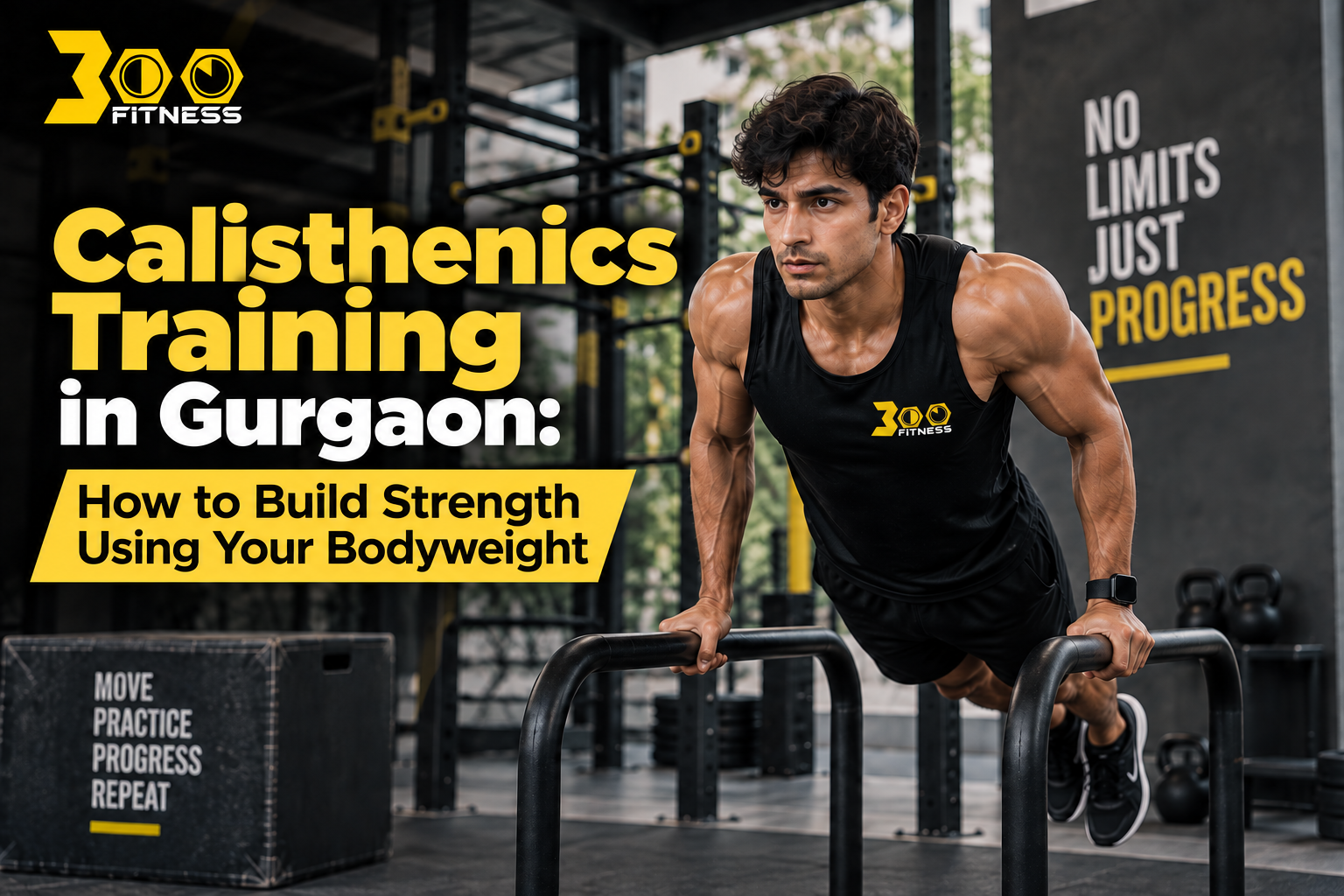
Calisthenics is resistance training that uses your bodyweight as the main source of resistance. Beginners build strength by learning easier versions of pushing, pulling, squatting and core exercises, then gradually moving towards harder variations as their control improves.
You do not need to start with muscle-ups, handstands or one-arm push-ups.
A useful beginner calisthenics program starts much earlier.
Learn to push your body away from the floor. Learn to pull your body towards a bar. Control your legs through squats and lunges. Build enough trunk strength to keep those movements organised. Then progress one step at a time.
If you are looking for calisthenics in Gurgaon, particularly around Sector 49, Sohna Road, South City 2 or Vipul Greens, the best starting program is not the one with the most impressive skills.
It is the one that gives you a progression you can actually follow.
How should a beginner start calisthenics?
Start with basic push, pull, leg and core movements at a difficulty you can control. An incline push-up may come before a floor push-up, and rows or assisted pull-ups may come before a full pull-up. Progress by improving repetitions, range, control or exercise difficulty. Two or three structured sessions each week can be a practical starting point for many beginners.
What Is Calisthenics?
Calisthenics is a form of resistance training in which your body provides most of the resistance.
Common exercises include:
- push-ups;
- pull-ups;
- rows;
- dips;
- squats;
- lunges;
- planks;
- hanging knee raises;
- more advanced bodyweight skills.
The important part is not the absence of dumbbells.
It is the way resistance is manipulated.
In weight training, you may progress from a 20 kg load to 25 kg.
In calisthenics, you may progress from an incline push-up to a floor push-up, then to a harder variation.
Both approaches use the same broad principle: the exercise gradually has to demand more from you if you want continued adaptation.
The American College of Sports Medicine’s 2026 resistance training guidance specifically notes that bodyweight exercises can produce meaningful improvements in strength, muscle development and physical function. It also emphasises consistency over unnecessarily complicated programming.
ACSM 2026 Resistance Training Guidelines
That makes calisthenics a legitimate form of strength training, not simply a warm-up before the “real” workout.
Basic Movement Patterns Beginners Should Learn
A beginner program becomes easier to understand when exercises are organised by movement instead of random difficulty.
1. Pushing
Pushing develops the chest, shoulders and triceps while teaching you to control your upper body.
A beginner might progress through movements such as:
Wall push-up → Incline push-up → Floor push-up → Harder push-up variations
You do not need to begin on the floor.
If you cannot perform a controlled floor push-up yet, raising your hands onto a stable surface is a sensible regression.
The goal is to choose a version you can perform well enough to practise repeatedly.
2. Pulling
Pulling tends to be more difficult for beginners because you usually need something sturdy to pull against.
Useful exercises can include:
- supported bodyweight rows;
- inverted rows;
- assisted pull-ups;
- controlled negative pull-ups;
- full pull-ups.
This is also where a training facility can become useful even though calisthenics is often described as “no-equipment exercise.”
Floor space is enough for push-ups and squats.
Pulling becomes easier to programme properly when you have access to a suitable bar, cable, assisted exercise or stable rowing setup.
3. Squatting and Single-Leg Training
Bodyweight leg training does not end with high-repetition air squats.
Progressions can include:
- assisted squat;
- bodyweight squat;
- reverse lunge;
- split squat;
- Bulgarian split squat;
- assisted single-leg variations.
As exercises become easier, you can also increase range, control or external resistance rather than performing endless repetitions.
4. Hinge and Posterior Chain Work
Calisthenics programs often overemphasise push-ups and pull-ups while neglecting hip-dominant movements.
Useful options may include:
- glute bridges;
- hip hinge drills;
- single-leg hip bridge variations;
- controlled single-leg hinge patterns.
A balanced program should train more than what looks impressive on social media.
5. Core Control
Core training is not limited to doing hundreds of crunches.
A useful progression might include:
- dead bug;
- plank;
- side plank;
- hollow body variations;
- hanging knee raises;
- advanced hanging or static holds later.
Your core helps transfer force while you push, pull, squat and hang.
That makes basic trunk control important long before advanced skills such as L-sits or front levers become relevant.
How Calisthenics Progressions Work
Calisthenics becomes effective strength training when exercises are progressed, not merely repeated forever.
There are several ways to progress.
Increase Repetitions
If you initially perform 6 controlled incline push-ups and later perform 12 with the same quality, you have improved.
Move to a Harder Variation
Once the easier movement no longer creates enough challenge, change the leverage.
For example:
Higher incline push-up → Lower incline → Floor push-up
Improve Range of Motion
A deeper, controlled movement can be harder than a partial repetition.
Improve Tempo and Control
Slowing the lowering portion of an exercise can make a movement more demanding.
This should be used deliberately, not just to make everything painfully slow.
Reduce Assistance
Assisted pull-ups provide a good example.
Over time you may:
- use more assistance;
- then moderate assistance;
- then less assistance;
- then perform an unassisted repetition.
Add External Resistance When Useful
Calisthenics does not forbid weights.
Once basic bodyweight exercises become easy, a weighted vest, belt or other appropriate resistance can provide another progression route.
The distinction between calisthenics and weight training becomes much less important than continuing to provide a useful training stimulus.
Beginner Calisthenics Progression Ladder
Calisthenics Progression Ladder for Beginners
Do not skip levels simply because the harder exercise looks better. Use the variation that lets you train with control.
The ladder is deliberately not attached to promises such as “get your first pull-up in 30 days.”
People progress at different rates.
Your starting strength, body weight, training frequency, technique, recovery and previous exercise experience all matter.
Can Calisthenics Actually Build Strength?
Yes, provided the exercise becomes challenging enough over time.
A controlled trial comparing progressive push-up training with bench press training found that both groups improved upper-body strength over four weeks. The calisthenics group also improved its push-up progression.
Another study comparing load-matched push-ups with low-load bench pressing found similar improvements in chest and triceps muscle thickness and bench press strength over eight weeks.
PubMed: Progressive Calisthenic Push-up Training
PubMed: Push-ups and Bench Press Muscle Adaptation Study
These studies are relatively small and should not be stretched into the claim that every bodyweight program is equal to every weight training program.
The more useful conclusion is that properly progressed bodyweight resistance can improve strength and muscle development.
Not Sure Which Bodyweight Progression Fits Your Level?
Visit 300 Fitness in Sector 49, Sohna Road and discuss how bodyweight exercises can fit into a structured strength and fitness routine.
Calisthenics vs Weight Training
Calisthenics and weight training are not enemies.
Both are resistance training tools.
| Factor | Calisthenics | Weight Training |
| Main resistance | Bodyweight | External load |
| Progression | Leverage, reps, range, tempo, assistance | Load, reps, sets, range, tempo |
| Equipment | Can be minimal | Usually requires weights or machines |
| Strength tracking | Sometimes less precise | Very easy to quantify |
| Skill component | Often high | Depends on exercise |
| Pulling work | Usually needs a bar or setup | Easy with machines and cables |
| Lower body loading | Can become difficult to progress | External load makes progression simpler |
| Good for | Body control, strength, accessible training | Strength, muscle development, precise loading |
Where Calisthenics Has an Advantage
Calisthenics is accessible.
Push-ups, squats and many core exercises can be practised almost anywhere.
It also gives you clear skill goals.
Your first push-up.
Your first pull-up.
Your first controlled dip.
Those milestones can make training engaging.
Where Weight Training Has an Advantage
Adding resistance is often easier to quantify.
If a squat becomes easy, adding 5 kg is straightforward.
In bodyweight training, you may need to change leverage, range or move towards a single-leg variation.
Lower body strength can eventually become particularly difficult to challenge with bodyweight alone.
Should You Combine Them?
For many people, yes.
A hybrid program can use:
- calisthenics for push-ups, pull-ups, dips and core work;
- free weights or machines for additional leg and posterior-chain loading;
- cables or assisted machines while building pulling strength;
- resistance training for areas that are awkward to progress through bodyweight alone.
Training method should serve the goal.
You do not receive extra fitness points for refusing to touch a dumbbell because you identify as a calisthenics trainee.
Building Pulling, Pushing and Core Strength
A balanced beginner plan should give all three areas enough attention.
Pushing Strength
A simple starting structure:
- incline or floor push-up;
- 2 to 3 working sets;
- controlled repetitions;
- progress when the current variation becomes consistently manageable.
Later, you can introduce:
- dips;
- pike push-ups;
- harder push-up variations.
Pulling Strength
Pulling deserves special attention because many beginner home programs neglect it.
Start at an achievable level.
You might use:
- bodyweight rows;
- assisted pull-ups;
- slow negative pull-ups.
Do not repeatedly jump at a pull-up bar and fail one repetition.
A progression should contain exercises you can actually train.
Core Strength
Choose exercises that teach control.
For example:
- dead bugs;
- planks;
- side planks;
- hollow holds.
Advanced static skills can come later.
A strong-looking L-sit means little if you skipped basic control and cannot organise your trunk during ordinary exercises.
A Simple Beginner Bodyweight Training Week
For many beginners, two or three full-body sessions can be enough to establish the habit.
Workout A
- Incline or floor push-up
- Bodyweight row
- Squat
- Reverse lunge
- Plank
Workout B
- Push-up variation
- Assisted pull-up or row
- Split squat
- Glute bridge
- Dead bug or hollow-body regression
A simple week could look like:
| Day | Training |
| Monday | Workout A |
| Tuesday | Walking or other activity |
| Wednesday | Workout B |
| Thursday | Recovery |
| Friday | Workout A |
| Weekend | Walking, mobility or another suitable activity |
The following week can begin with Workout B.
This is an example, not an individual prescription.
ACSM’s current resistance training guidance recommends training major muscle groups at least twice weekly and stresses that programmes should be individualised enough to remain sustainable.
How Often Should You Train Calisthenics?
Two or three sessions per week is a practical starting point for many beginners.
That gives you repeated practice without forcing every day to become a strength session.
As your experience grows, frequency can change.
Someone practising handstands may perform small amounts of skill work more frequently.
Someone doing demanding pull-up and dip sessions may need more recovery.
The 300 Fitness Workout Analysis also focuses on finding the right balance between insufficient training, progression and excessive training.
The important question is not:
“How many days can I train?”
Ask:
“How many productive sessions can I recover from and repeat?”
How Long Does It Take to Get Your First Pull-Up?
There is no honest universal timeline.
For one person it may take weeks.
For another it may take months.
Someone starting very close to a pull-up has a very different task from someone who cannot yet hold their body securely from the bar.
Progress can depend on:
- current pulling strength;
- body weight;
- grip strength;
- training frequency;
- technique;
- consistency;
- recovery;
- previous training experience.
Instead of setting a fake date, track intermediate progress.
For example:
- Can you hang from the bar comfortably?
- Can you perform controlled rows?
- Can you control the shoulder blades while hanging?
- Can you perform assisted pull-ups?
- Can you lower yourself slowly from the top?
- Can you reduce assistance over time?
Those are measurable improvements even before the first full repetition appears.
Can Calisthenics Build Muscle?
Yes, if the exercises provide enough resistance and are progressed over time.
Bodyweight resistance is still resistance.
Research comparing appropriately loaded push-ups with bench pressing found similar improvements in selected upper-body muscle thickness over the study period.
A 2026 randomised study in adults with obesity also reported improvements in several physical fitness outcomes after a 12-week calisthenics programme, although the findings apply to that specific population and programme rather than every calisthenics routine.
PubMed: 12-Week Calisthenics Exercise Trial
Muscle development still depends on:
- sufficient training stimulus;
- enough weekly work;
- adequate nutrition;
- recovery;
- progression.
If your current push-up variation allows 50 easy repetitions, doing the same exercise forever may stop being an efficient muscle-building strategy.
Make the movement harder or add suitable resistance.
Common Beginner Calisthenics Mistakes
Chasing Skills Before Building Strength
Muscle-ups and handstands attract attention.
They are not beginner foundations.
Build push, pull, leg and core strength first.
Doing Only Push-Ups
Push-ups are convenient, which is exactly why beginner programs often become push-heavy.
Train pulling too.
Testing Pull-Ups Instead of Training Pull-Ups
Repeatedly attempting a movement you cannot perform is not much of a progression plan.
Use rows, assistance and controlled negatives.
Progressing Too Quickly
A harder variation is not automatically better.
If range, control and technique disappear, step back.
Ignoring Legs
Calisthenics should not mean upper body street workout only.
Squats, lunges, split squats and hip-dominant work still matter.
Copying Advanced Athletes
Someone performing planche push-ups may have trained for years.
Their workout does not become beginner friendly simply because you reduce the number of sets.
Never Tracking Anything
Record:
- exercise variation;
- sets;
- repetitions;
- assistance used;
- hold time where relevant.
Progress is much easier to manage when you know what you did last time.
Why a Gym Can Still Be Useful for Calisthenics
Calisthenics is often promoted as training that requires no gym.
That is partly true.
You can perform many exercises anywhere.
But a gym environment can still be useful for:
- access to stable pulling equipment;
- assisted pull-up variations;
- cables or machines for developing weak movement patterns;
- additional resistance when bodyweight becomes too easy;
- structured programming;
- trainer feedback;
- combining calisthenics with conventional strength work.
This can be particularly useful for someone living around South City 2 or Vipul Greens who wants bodyweight training in Gurgaon but also wants the flexibility to combine it with other strength methods.
You can review the broader 300 Fitness approach and Fit School for the brand’s focus on structured, sustainable training.
How Calisthenics Fits #300MinutesPerWeek
The #300MinutesPerWeek idea does not mean performing 300 minutes of pull-ups.
Your weekly movement can include several activities.
For example:
| Activity | Weekly Example |
| Calisthenics / Strength | 3 × 50 minutes |
| Walking or Moderate Cardio | 3 × 30 minutes |
| Mobility or Other Activity | 60 minutes |
| Total | 300 minutes |
This is simply an illustration.
WHO recommends adults combine regular aerobic activity with muscle-strengthening work across the week rather than relying on only one type of exercise.
WHO India Physical Activity Guidance
Calisthenics can cover part of the strength component.
Walking, cycling, group exercise or other cardiovascular activity can fill a different role.
Choosing Calisthenics Training in Gurgaon
Current Gurgaon search results show that local calisthenics options often focus on:
- bodyweight strength;
- pull-ups and handstands;
- functional movement;
- skill development;
- beginner progressions;
- hybrid bodyweight and weight training.
That gives you a useful checklist before joining any calisthenics classes in Gurgaon.
Ask:
- Is the program suitable for complete beginners?
- Are exercises scaled to different strength levels?
- Is there a clear push-up and pull-up progression?
- Does the program train legs and core too?
- Are advanced skills taught only after foundations?
- Can calisthenics be combined with weight training?
- Is progress recorded?
- Can you get technique feedback?
- Is the location convenient enough to attend consistently?
- Does the training schedule fit around work and Gurgaon traffic?
For someone around South City 2 or Vipul Greens, convenience to Sector 49 and Sohna Road can matter more than it first appears.
A perfect calisthenics program you attend once every two weeks is not particularly useful.
Consistency still wins.
How Calisthenics Can Fit the 300 Fitness Approach
300 Fitness describes its Fit School around fitness fundamentals, sustainable progress and structured workout planning, and its live site also references personalised workout plans, group classes and nutrition guidance.
That broader approach fits calisthenics well because bodyweight training still needs structure.
You need to know:
- which variation to use;
- how many quality sets to perform;
- when to increase difficulty;
- when to reduce assistance;
- how to balance push and pull work;
- when additional resistance may be useful.
Calisthenics does not remove programming.
It simply changes some of the tools.
If you specifically want calisthenics coaching or classes, confirm the current available training format with 300 Fitness directly rather than assuming a dedicated class is currently scheduled.
Build the Strength First, Then Earn the Skills
Visit 300 Fitness in Sector 49, Sohna Road and discuss how bodyweight exercises, structured strength training and progressive workouts can fit your goals.
Visit 300 FitnessFrequently Asked Questions
Is calisthenics good for beginners?
Yes. Calisthenics is highly scalable because exercises can be made easier or harder. A beginner who cannot yet perform floor push-ups or pull-ups can start with incline push-ups, rows and assisted pulling movements before progressing.
Can calisthenics build muscle?
Yes. Bodyweight resistance can support muscle development when exercises are sufficiently challenging and progressively overloaded. Research on push-up training has shown improvements in muscle thickness and strength when the exercise load is appropriately matched.
Is calisthenics better than weight training?
Neither is universally better. Calisthenics is excellent for body control, accessible strength training and skill development. Weight training makes precise load progression easier, particularly for lower-body and muscle-building goals. Many people benefit from combining both.
How often should I train calisthenics?
Two or three structured strength sessions per week can be a practical starting point for many beginners. Frequency can change with experience, training volume, skill practice and recovery.
How long does it take to get a first pull-up?
There is no reliable universal timeline. Your starting strength, body weight, grip, technique, training frequency and recovery all influence progress. Track rows, assistance levels, negative pull-ups and hanging strength instead of relying on a fixed deadline.
Do I need equipment for calisthenics?
Some exercises require almost no equipment, including push-ups, squats, lunges and many core movements. Balanced pulling work is easier with access to a pull-up bar, rings, a stable row setup or suitable gym equipment.
Can I combine calisthenics with gym workouts?
Yes. Calisthenics and conventional strength training can complement each other. You can use bodyweight movements for pushing, pulling and core work while using free weights or machines where external resistance offers simpler progression.
Can calisthenics help with fat loss?
Calisthenics contributes to physical activity and resistance training, but it does not guarantee fat loss. Changes in body fat depend on overall energy balance, nutrition, total activity and consistency.
Should beginners train advanced calisthenics skills?
Beginners can practise suitable skill foundations, but strength basics should come first. Muscle-ups, front levers, planches and advanced handstand work require levels of strength and control that usually need progressive preparation.
Where can I enquire about calisthenics or bodyweight training in Sector 49 Gurgaon?
300 Fitness is based in the Sector 49 and Sohna Road area of Gurugram. Contact the team directly to discuss bodyweight exercises, structured strength training and whether dedicated calisthenics training is currently available.