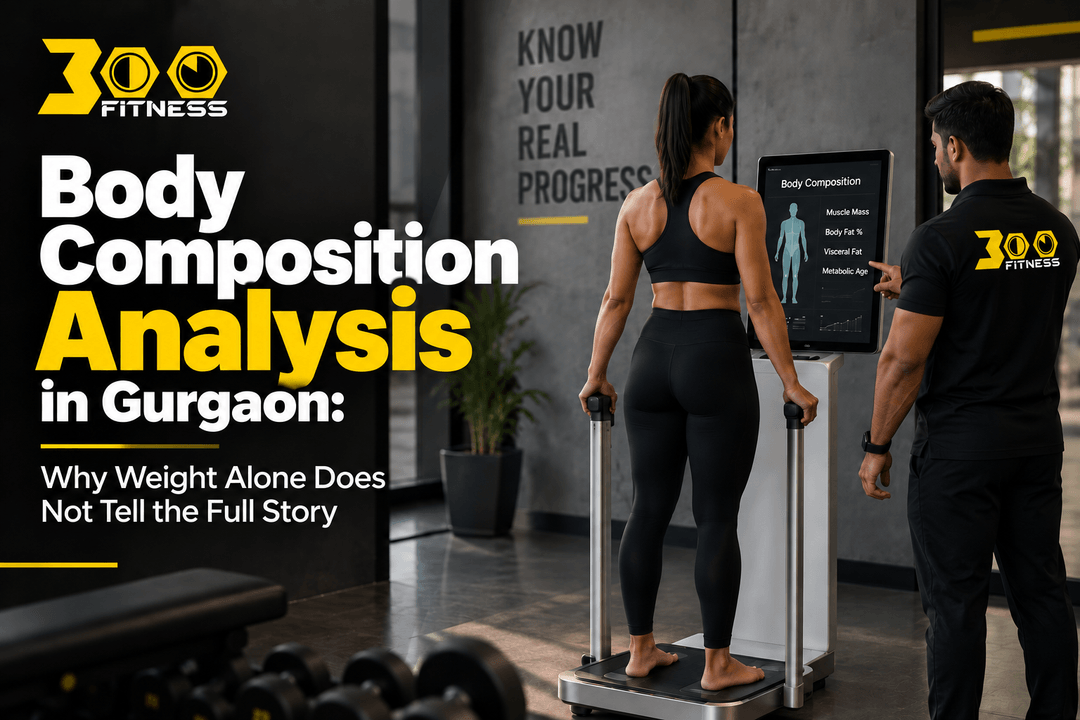
Body composition analysis looks beyond your total body weight by estimating how that weight is distributed across components such as body fat and fat-free or muscle-related mass. For fitness tracking, this can provide useful context that a weighing scale alone cannot show.
That does not make body composition testing a perfect measurement or a medical diagnosis.
It is better viewed as one piece of a larger fitness assessment.
For someone looking for body composition analysis in Gurgaon, especially around Sector 49, Sohna Road, Sispal Vihar or Uppal Southend, the most useful approach is to establish a baseline, repeat measurements under similar conditions and interpret the trend alongside strength, stamina, training consistency and other fitness outcomes.
Why measure body composition instead of only body weight?
Body weight tells you how heavy you are, but not how that weight is distributed. A body composition assessment can estimate metrics such as body fat and muscle-related mass, depending on the method and equipment used. The results are most useful for tracking trends under consistent testing conditions, not as exact medical measurements or numbers that should be judged in isolation.
What Is Body Composition?
Body composition describes the components that make up your total body mass rather than treating your body as one single number.
At a practical fitness level, people are usually interested in the relationship between:
- fat mass;
- fat-free mass;
- muscle-related measurements;
- body water;
- total body weight.
More advanced assessment methods can describe additional compartments, but different technologies measure or estimate different things.
That distinction matters.
A gym-based body composition machine, a DXA scan, skinfold measurement and a laboratory multi-compartment assessment are not interchangeable methods.
Current scientific guidance also stresses the importance of using body-composition terms carefully. For example, skeletal muscle, fat-free mass and lean soft tissue describe different concepts and should not automatically be treated as identical.
For a regular gym member, you do not need to become a body-composition researcher.
You do need to understand that the numbers on a report are estimates produced by a particular method.
Body Weight vs Body Composition
A weighing scale answers one question:
What is your total body weight right now?
That can still be useful.
It is simple, inexpensive and easy to track.
But it cannot tell you what changed inside that total.
Consider two hypothetical examples.
Example 1: Weight Stays Similar
A person begins strength training and improves nutrition.
Several weeks later, their body weight is similar.
If they only watch the weighing scale, they may assume nothing changed.
But it is possible for changes in fat mass and muscle-related mass to partly offset each other.
A body composition assessment may provide additional context.
Example 2: Weight Drops Quickly
Another person sees a sudden drop on the scale.
That does not automatically mean the same amount of body fat was lost.
Short-term body weight can be influenced by water, food intake and other variables.
This is why fitness progress should not be reduced to one morning’s scale reading.
What About BMI?
BMI uses body weight relative to height.
It remains a widely used screening measure, particularly at the population and healthcare level.
But BMI does not directly measure body fat and cannot distinguish fat mass from muscle and bone mass. The CDC recommends interpreting BMI alongside other relevant information rather than treating it as a complete individual assessment.
So is body composition “better” than BMI?
Not in every context.
They answer different questions.
BMI: A simple weight-for-height screening measure.
Body composition: An estimate of how body mass is distributed among different compartments.
For fitness programming, body composition can provide context that BMI and body weight alone do not provide.
For medical risk assessment, a gym body composition result should not replace proper healthcare evaluation.
Common Metrics in a Body Composition Assessment
The exact numbers depend on the device or assessment method.
300 Fitness currently lists Body Composition Analysis as part of several membership journeys and states that monthly fitness assessments can help track changes in muscle mass and fat percentage.
The current site does not publicly specify the exact body-composition device or measurement technology, so this article does not assume that every metric below appears on a 300 Fitness report.
| Metric | What It Generally Means | What to Remember |
| Body Weight | Total mass measured by the scale | Does not show what the weight consists of |
| Body Fat Percentage | Estimated proportion of total weight represented by fat mass | Method-dependent estimate, not an exact diagnosis |
| Fat Mass | Estimated total mass attributed to body fat | Useful mainly as part of a trend |
| Fat-Free Mass | Body mass excluding fat | Includes more than skeletal muscle |
| Skeletal Muscle Estimate | Estimated muscle-related tissue, if the device reports it | Not identical to total fat-free mass |
| Total Body Water | Estimated amount of water in the body, if measured | Hydration can influence some assessment methods |
| BMI | Weight relative to height | Screening metric, not direct body-fat measurement |
| Visceral-Fat Indicator | Device-specific estimate on some systems | Should not be treated as a clinical diagnosis |
Do Not Treat Every Number as Equally Important
A report can look impressive because it contains many metrics.
More metrics do not automatically mean more useful information.
Start with the numbers that relate directly to your training goal.
If your goal is fat loss, look at body-weight trends, estimated body-fat trends, strength and consistency.
If your goal is muscle gain, look at resistance-training performance, body-weight changes and relevant composition trends.
If your goal is general fitness, also consider stamina, strength, movement quality and adherence.
What Does a Body Composition Analysis in Gurgaon Actually Add to Your Fitness Plan?
The main value is context.
Suppose two members both want to “lose 5 kg.”
That goal sounds specific, but it may not lead to the same training plan.
One person may already have relatively little muscle mass and need a larger emphasis on progressive strength training.
Another may primarily need better consistency, nutrition structure and total weekly activity.
A third person may not need to make scale weight the central goal at all.
A body composition assessment can help start a better conversation:
- What are we trying to change?
- What should we preserve?
- What training should receive priority?
- What other fitness markers should we track?
At 300 Fitness, body composition sits within a broader membership journey that also includes understanding fitness goals, fitness assessment, workout cards and monthly fitness review on selected plans.
That is a more useful context than viewing a BCA result as a standalone score.
Want a Clearer Starting Point Than Body Weight Alone?
Visit 300 Fitness in Sector 49, Sohna Road to discuss your fitness goals, available assessment options and a more structured approach to tracking progress.
How Accurate Are Body Composition Machines?
Body composition machines can be useful for estimating and tracking trends, but the numbers should not be treated as exact measurements of your body’s true composition.
This is especially important for bioelectrical impedance analysis, commonly called BIA.
BIA sends a small electrical current through the body and uses electrical impedance plus prediction equations to estimate body-composition variables.
Many commercial fitness devices use versions of this technology, although again, the current 300 Fitness website does not specify which method its assessment uses.
A 2026 systematic review comparing BIA devices with a four-compartment reference model found substantial individual-level disagreement for estimated body-fat percentage and fat-free mass. The authors concluded that the BIA devices studied were not equivalent to the reference method at the individual level.
That does not make BIA useless.
It changes how the result should be used.
Think:
trend indicator
rather than:
perfect measurement of exactly how many kilograms of muscle and fat you have.
Why Trends Can Still Be Useful
If you repeatedly use:
- the same device;
- similar testing conditions;
- a consistent protocol;
you reduce some of the noise that can make comparisons difficult.
You are asking:
“Is this estimate moving consistently in the direction we expect?”
rather than:
“Is this number correct to the decimal point?”
Why Measurement Conditions Matter
Testing conditions can influence body-composition results.
This is particularly relevant if the assessment method uses bioelectrical impedance.
The NIH consensus statement on BIA notes that results can be affected by factors including:
- hydration;
- food and beverage intake;
- recent physical activity;
- body position;
- skin and environmental temperature.
It recommends standardisation when repeat measurements are compared.
The Wrong Way to Compare Tests
Test 1: Morning, before breakfast, rested.
Test 2: Evening, after a large meal, after training.
If the numbers differ, you now have two things changing:
- your body;
- the measurement conditions.
That makes interpretation harder.
Better Repeat-Testing Practice
Try to repeat the assessment:
- at a similar time of day;
- with similar hydration habits;
- under similar food-intake conditions;
- without comparing immediately after a hard workout with a fully rested test;
- using the same device where possible.
The goal is not laboratory perfection.
It is consistency.
Body Composition Testing Checklist
Make Repeat Tests Easier to Compare
The exact preparation instructions should come from the facility and device being used. As a general tracking principle, keep testing conditions as similar as practical.
How Often Should You Repeat a Body Composition Test?
There is no universal frequency that is correct for everyone.
Repeating the assessment every few days rarely adds useful information for ordinary fitness planning.
Body composition changes slowly enough that short-term measurement noise can easily distract from the larger trend.
A more useful approach is to repeat assessments at planned intervals that match your training-review process.
300 Fitness currently states that it conducts monthly Fitness Assessment Tests to help track changes in muscle mass, fat percentage and overall fitness.
That provides a practical review rhythm.
The more important point is consistency.
If you test monthly, try to reproduce similar conditions each month.
Do You Need to Test Every Month?
Not necessarily.
Testing frequency can depend on:
- your goal;
- the assessment method;
- how quickly meaningful change is expected;
- whether the result will actually change a training decision.
If you are already following a stable plan and progressing well, more frequent measurement does not automatically improve the program.
Can Body Composition Analysis Track Muscle Gain?
It can provide an estimate of changes in muscle-related or fat-free mass, depending on the technology.
But do not use that estimate alone to decide whether your strength program is working.
Pair it with training data such as:
- loads lifted;
- repetitions;
- exercise technique;
- training consistency;
- body-weight trend;
- relevant measurements.
Suppose a machine reports increased muscle mass but your strength, training volume and body weight have not changed meaningfully.
That result deserves context, not automatic celebration.
The reverse is also true.
If your estimated muscle value barely moves over a short interval but your strength is progressing consistently, do not assume the program failed.
Measurement error exists.
How to Use Results for Fat Loss Decisions
For a fat-loss goal, body composition can help you look beyond scale weight.
A useful progress review might ask:
- Is body weight trending in the intended direction?
- What is happening to estimated body-fat measures?
- Is strength being maintained or improving?
- Are workouts progressing?
- Is the nutrition plan realistic enough to follow?
- Is weekly activity consistent?
This produces a more complete picture than:
“I lost 800 grams this week, so everything is perfect.”
300 Fitness currently combines fitness assessment, workout planning and nutrition guidance within selected membership journeys, which allows the numbers to be interpreted as part of a broader training plan rather than in isolation.
How to Use Results for Muscle-Gain Decisions
For someone focused on muscle gain, the objective is not simply making total body weight increase as quickly as possible.
A useful review combines:
- body-weight trend;
- resistance-training progression;
- estimated composition trend;
- nutrition consistency;
- recovery.
If body weight is increasing but gym performance is stagnant and the composition trend is moving in an unwanted direction, the plan may need reviewing.
If strength, training quality and relevant measurements are improving, the picture is more encouraging.
Again, no single machine number should make the entire decision.
Body Composition Analysis Is Not a Medical Diagnosis
This deserves its own section.
A gym body composition assessment can support fitness planning.
It should not be used to diagnose:
- metabolic disease;
- cardiovascular disease;
- hormonal disorders;
- nutritional deficiencies;
- medical obesity complications;
- any other health condition.
Even sophisticated body-composition methods have methodological limitations, and commercial BIA devices can differ in their prediction equations and individual-level accuracy.
If you have a medical concern, abnormal symptoms or need clinical interpretation, speak with an appropriate healthcare professional.
The purpose of gym-based testing is narrower:
fitness assessment, goal setting and progress tracking.
What to Look for in a Body Composition Test in Gurgaon
Current Gurgaon search results show body composition testing across gyms, fitness centres, physiotherapy centres and diagnostic providers.
The common commercial message is usually:
- body fat measurement;
- muscle mass;
- hydration;
- progress tracking;
- personalised fitness planning.
The missing piece is often interpretation.
Before choosing a body composition test in Gurgaon, ask:
- What measurement method or device is being used?
- Which metrics does it actually estimate?
- How should I prepare before the test?
- Will repeat tests use the same method?
- How will the result influence my workout plan?
- Will someone explain the limitations of the numbers?
- Is the assessment for fitness tracking or medical diagnosis?
- How often is repeat testing actually useful?
- Will strength and fitness performance also be tracked?
- Is the location convenient enough for consistent follow-up?
For people around Sispal Vihar or Uppal Southend, Sector 49 and Sohna Road may be a practical location for combining an assessment with regular training rather than travelling somewhere different each time.
Consistency in the training process matters more than collecting reports.
How Body Composition Fits the 300 Fitness Approach
The current 300 Fitness membership journey includes:
- understanding fitness goals;
- Body Composition Analysis on selected plans;
- Fitness Assessment Test;
- personalised Workout Card;
- nutrition guidance depending on plan;
- Monthly Fitness Review.
That structure is useful because body composition is not treated as the fitness goal itself.
The numbers can help establish a baseline.
The workout plan creates the training process.
Nutrition guidance can support the goal where relevant.
The monthly review asks whether the overall plan is moving in the intended direction.
That is a healthier way to use fitness data than allowing one percentage on a machine to decide whether you had a “good” or “bad” month.
Track More Than the Number on the Scale
Visit 300 Fitness in Sector 49, Sohna Road to discuss body composition, fitness assessment and how progress tracking can support a more structured workout plan.
Visit 300 FitnessFrequently Asked Questions
What does a body composition test measure?
A body composition test estimates how total body mass is distributed across different components. Depending on the method and device, a report may include body-fat percentage, fat mass, fat-free mass, muscle-related estimates, body water and other indicators.
Is body composition more useful than BMI?
They serve different purposes. BMI is a simple weight-for-height screening measure, while body composition attempts to estimate components such as fat and fat-free mass. For fitness tracking, body composition can add useful context, but neither should be treated as a complete medical assessment.
How accurate are body composition machines?
Accuracy varies by technology, device and individual. Commercial bioelectrical impedance devices can show meaningful individual-level differences compared with reference methods. They are generally more useful for cautious trend tracking than for treating every reported value as exact.
How often should I do a body composition analysis?
There is no universal schedule. Planned repeat testing is more useful than frequent testing, especially when measurements are taken under similar conditions. 300 Fitness currently uses monthly fitness reviews as part of selected membership journeys.
Can body composition testing track muscle gain?
It can estimate changes in muscle-related or fat-free mass depending on the device. Use that information alongside strength progression, workout performance and body-weight trends rather than relying on the machine estimate alone.
Why can two people at the same weight have different body composition?
Total body weight combines several components. Two people can weigh the same while carrying different amounts of fat mass, muscle-related mass, water and other tissues. A weighing scale cannot distinguish between those components.
Can hydration affect a body composition test?
Yes, particularly with bioelectrical impedance methods. Hydration, recent food intake and exercise can influence BIA measurements, which is why repeat tests are easier to interpret when testing conditions are kept similar.
Should I test body composition before starting a gym program?
A baseline assessment can be useful if the results will help clarify goals or provide a future comparison point. It is not mandatory for everyone, and it should be considered alongside fitness level, training history and practical performance measures.
Is a BCA test a medical test?
A gym-based BCA or body composition assessment should generally be treated as a fitness-assessment tool, not a medical diagnostic test. Medical concerns require appropriate clinical evaluation.
Where can I get body composition analysis near Sector 49 Gurgaon?
300 Fitness in the Sector 49, Sohna Road area includes Body Composition Analysis within selected membership journeys. Contact the gym directly to confirm the current assessment process and what is included in the relevant plan.