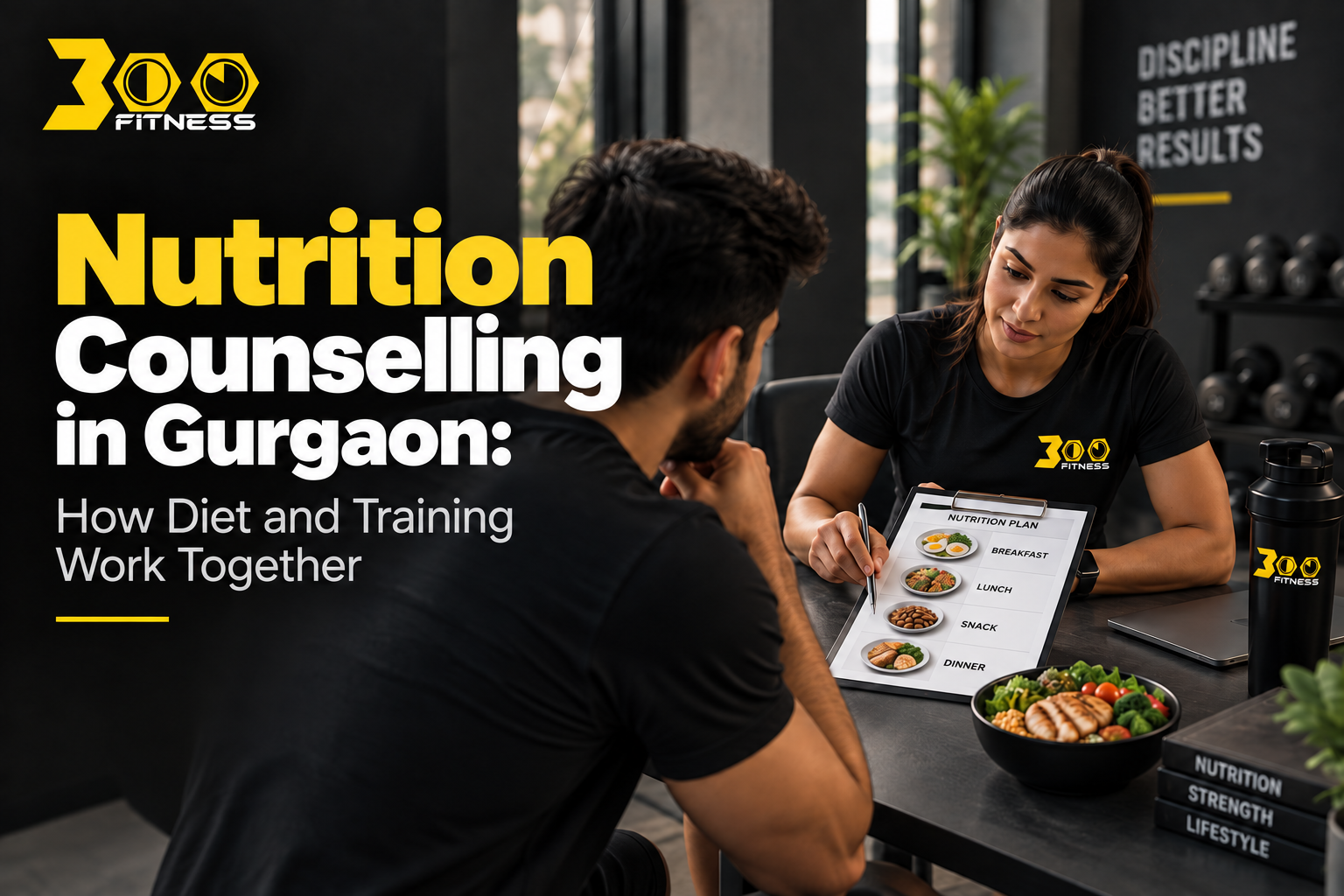
Nutrition counselling for fitness should connect what you eat with what you are actually trying to achieve in training. A useful plan considers your goal, normal food preferences, daily routine, workout schedule and ability to follow the plan consistently. It should not depend on extreme restrictions, unnecessary food rules or a generic diet chart copied for everyone.
That matters whether your goal is fat loss, muscle gain, strength or simply having enough energy to train regularly.
For someone searching for nutrition counselling in Gurgaon, particularly around Sector 49, Sohna Road, Orchid Petals or Vatika City, the practical question is not just, “What should I eat?”
A better question is:
What eating pattern supports my training goal and still works on normal Gurgaon workdays, busy evenings, weekends and social occasions?
How should diet and training work together?
Your diet should provide enough energy and nutrients for your training while supporting the goal you are working towards. Protein supports muscle-related adaptations, carbohydrates are an important energy source, dietary fats remain essential, and hydration matters for exercise. The best plan is not necessarily the strictest one. It is the one that is nutritionally sensible, goal-specific and practical enough to follow consistently.
Why Nutrition Matters for Training
Training creates the stimulus.
Nutrition helps provide the energy and raw materials needed to support that training.
Those two parts should work together.
Someone lifting weights several times per week does not have the same practical nutrition demands as someone who is mostly inactive.
A runner, strength trainee and person starting a fat-loss program may all benefit from slightly different meal structures.
WHO’s current healthy-diet guidance recognises that the exact composition of a balanced diet varies with factors including age, lifestyle, physical activity, food availability and dietary customs. Its core principles emphasise adequacy, balance, moderation and dietary diversity.
Read WHO India healthy diet guidance
Training Cannot Fully Compensate for an Unsustainable Diet
A hard workout does not automatically cancel every eating habit.
Likewise, a carefully planned meal pattern cannot replace progressive training if your goal is strength or muscle development.
This is why a diet and workout plan in Gurgaon should connect the two.
For example:
Fat loss: Nutrition helps manage energy intake, while resistance training and other activity support fitness and help preserve useful physical capacity.
Muscle gain: Progressive resistance training provides the main training stimulus, while sufficient food and protein support adaptation and recovery.
Endurance: Training develops aerobic capacity, while food and fluids support repeated exercise.
General fitness: A balanced diet makes it easier to train consistently without turning nutrition into a second full-time job.
Protein, Carbohydrates and Fats in Simple Terms
You do not need to become obsessed with macronutrient mathematics to understand the basics.
Protein
Protein provides amino acids used throughout the body and is particularly relevant to people performing resistance training.
Research involving healthy adults has found that increasing protein intake alongside resistance training can modestly enhance gains in lean mass and strength compared with resistance training without additional protein.
Read the protein and resistance-training meta-analysis
Common protein-containing foods include:
- dals and pulses;
- dairy foods;
- eggs;
- fish;
- poultry;
- meat;
- soy foods;
- beans;
- other suitable plant and animal protein sources.
The useful goal is not to buy the largest supplement tub available.
First ask whether your normal meals contain enough appropriate protein across the day.
Carbohydrates
Carbohydrates are a major energy source.
WHO guidance recommends that carbohydrate intake for most people should primarily come from foods such as:
- whole grains;
- vegetables;
- fruits;
- pulses.
Carbohydrate needs can vary with total activity and training demands.
That is why removing rice or roti automatically is not a serious nutrition strategy.
For someone performing demanding gym workouts, running or group fitness, carbohydrates can have a practical role in fuelling training.
The amount and meal structure should reflect the person.
Dietary Fats
Fat is also an essential nutrient.
WHO recommends prioritising unsaturated fats while limiting saturated and trans fats within an overall balanced diet.
Useful sources can include appropriate amounts of:
- nuts;
- seeds;
- fish;
- certain vegetable oils;
- other foods containing unsaturated fats.
The takeaway is simple:
Protein, carbohydrates and fats all have a role.
A good nutrition plan does not need to make one macronutrient the villain.
Do Gym Members Need Protein Supplements?
Not automatically.
A protein supplement is a convenient food product, not a requirement for joining a gym.
If your normal diet already provides appropriate protein, a supplement may offer little practical advantage beyond convenience.
It may be useful when:
- meals are difficult to organise around work;
- appetite makes it difficult to meet nutrition goals;
- a convenient portable protein option helps adherence.
Whole foods can still provide protein.
Supplements should solve a practical problem, not create the impression that muscle gain comes from a shaker bottle.
Hydration and Workout Performance
Hydration is another part of fitness nutrition that people often either ignore or overcomplicate.
You lose fluid through sweat during exercise.
How much varies with:
- exercise duration;
- intensity;
- environmental temperature;
- individual sweat rate;
- clothing;
- body size.
Research shows that hydration status can influence exercise performance, although the size of the effect varies by exercise type, environmental conditions and study design. Fluid replacement after dehydration appears particularly relevant for longer continuous exercise and hotter environments.
Read the hydration and performance review
Do You Need Sports Drinks for Every Workout?
No.
For many normal gym sessions, water and regular meals may be sufficient.
Sports drinks can have a role in specific situations involving prolonged exercise, high sweat losses or particular carbohydrate and electrolyte needs, but they are not automatically necessary because you exercised for 45 minutes.
A Practical Hydration Habit
Instead of trying to hit a dramatic universal water target, pay attention to:
- drinking regularly across the day;
- arriving at training reasonably hydrated;
- having access to fluid during exercise;
- replacing fluid after very sweaty sessions.
Individual requirements vary.
Nutrition for Fat Loss vs Muscle Gain
The same foods do not suddenly become “fat-loss foods” or “muscle-gain foods.”
The larger nutrition strategy changes.
| Goal | Main Nutrition Focus | Training Connection |
| Fat Loss | Sustainable reduction in energy intake while maintaining diet quality | Keep resistance training and regular physical activity |
| Muscle Gain | Sufficient energy and protein to support progressive training | Prioritise progressive resistance training |
| Strength | Adequate nutrition to support training quality and recovery | Track progressive overload and performance |
| Endurance | Enough energy and carbohydrates for repeated aerobic work | Build running or cardio progressively |
| General Fitness | Balanced meals and consistency | Combine strength, cardio and regular movement |
Nutrition for Fat Loss
Fat loss requires an energy imbalance over time in which energy intake is lower than energy expenditure.
That does not mean the most aggressive possible diet is the best one.
The US National Institute of Diabetes and Digestive and Kidney Diseases emphasises following a healthy eating pattern that can be maintained over time and combining it with physical activity.
NIDDK guidance on eating and physical activity
For a gym member, a useful fat-loss approach may include:
- manageable portions;
- sufficient protein;
- fruit and vegetables;
- sensible carbohydrate choices;
- consistent meal habits;
- progressive resistance training;
- regular physical activity.
You do not need to remove every food you enjoy.
Nutrition for Muscle Gain
Muscle gain requires the training stimulus first.
Resistance training tells the body there is a reason to adapt.
Protein and sufficient overall nutrition support that process.
Research consistently shows a relationship between resistance training, dietary protein and lean-mass adaptation in healthy adults.
A muscle-gain diet also should not become uncontrolled overeating.
More food does not automatically mean more muscle.
Training quality, sufficient nutrition, recovery and patience still matter.
Want Your Diet to Support the Training You Are Already Doing?
Visit 300 Fitness in Sector 49, Sohna Road to discuss your fitness goal, workout structure and the nutrition guidance available within current membership options.
Why Practical Meal Planning Beats Extreme Diets
The best theoretical diet has very little value if you stop following it after ten days.
This is one of the clearest themes across current Gurgaon nutrition searches.
People are not only looking for calorie numbers.
They want plans that account for:
- Indian food;
- work schedules;
- vegetarian or non-vegetarian preferences;
- eating outside the home;
- travel;
- family meals;
- fitness goals;
- follow-up adjustments.
That makes sense.
WHO’s healthy-diet framework itself notes that a healthy eating pattern varies according to local foods, cultural context, lifestyle and individual needs.
An Extreme Plan Creates More Problems Than It Solves
A plan may look disciplined because it:
- removes multiple food groups;
- uses the same meals daily;
- bans all restaurant food;
- requires complicated preparation;
- forces meal times that conflict with work.
But if the plan cannot survive a normal week, it is not particularly personalised.
A useful personalised diet plan in Gurgaon should account for real constraints.
For example, someone commuting between office and Sohna Road may need portable food options.
A member living in Vatika City who trains after work may need a different meal structure from someone training early morning.
A person from Orchid Petals working from home may have more control over meal preparation but a different problem, such as unplanned snacking.
Nutrition counselling should solve practical friction.
A Sustainable Fitness Nutrition Framework
Five Questions a Practical Diet Plan Should Answer
A useful plan should fit the person before it tries to optimise small details.
What Happens During Nutrition Counselling?
A fitness-focused nutrition consultation should first gather context.
That can include:
- your main fitness goal;
- current eating habits;
- food preferences;
- dietary restrictions;
- training schedule;
- work routine;
- meal timing;
- relevant lifestyle factors;
- challenges with following previous plans.
Then the guidance can focus on practical changes.
This may mean:
- improving protein distribution;
- changing portions;
- creating easier meals;
- planning food around training;
- addressing hydration;
- organising meals for office or travel;
- reviewing progress later.
The aim should not be to make food unnecessarily complicated.
Does Everyone Need a Detailed Diet Chart?
No.
Some people benefit from a structured written plan.
Others mainly need clear principles and a few behavioural changes.
For example, one member may need a detailed diet plan in Gurgaon because their meals are irregular and they want clear structure.
Another may already eat reasonably well but need help with:
- protein intake;
- pre-workout meals;
- portion control;
- evening snacking.
Personalisation should determine the amount of structure.
When Nutrition Counselling May Help
Nutrition counselling can be particularly useful if:
- you train consistently but your eating pattern has no structure;
- you repeatedly start and stop restrictive diets;
- your workout goal has changed;
- you struggle to plan protein-rich meals;
- your work schedule disrupts meal consistency;
- you are confused by conflicting fitness nutrition advice;
- you want training and nutrition to follow the same goal.
There is also a limit to fitness nutrition counselling.
If you need nutrition treatment for a medical condition, complex gastrointestinal symptoms, diagnosed eating disorder, kidney disease, diabetes management, pregnancy-related medical nutrition or another clinical issue, use an appropriately qualified healthcare or dietetics professional.
A gym nutrition plan should not pretend to replace medical nutrition therapy.
How Nutrition Fits With Personal Training
Personal training and nutrition should not operate in opposite directions.
If your training plan is designed for muscle gain while your food intake is extremely restrictive, the two strategies conflict.
If your goal is fat loss but your workout structure is so demanding that you cannot recover or maintain it, simply cutting food further may make the overall plan harder to follow.
300 Fitness currently states that its personal training includes goal setting, customised workout planning and nutrition guidance alongside exercise. Its membership options also include different levels of Diet Chart, Personalised Nutrition Guidance or General Nutrition Guidance depending on the plan.
Explore the 300 Fitness services and personalised training options for current details.
How the 300 Fitness Nutrition Approach Connects With Training
The current 300 Fitness website places nutrition inside a broader membership journey rather than presenting it as an isolated service.
Depending on the membership plan, the published journey can include:
- understanding fitness goals;
- Body Composition Analysis;
- Fitness Assessment Test;
- Workout Card;
- Diet Chart or nutrition guidance;
- Monthly Fitness Review.
The site also describes its Diet Plans as personalised around health objectives, lifestyle and dietary preferences or restrictions, with a balanced approach intended to fit different cuisines and routines.
That is relevant because nutrition should change for a reason.
A sensible review may ask:
Is the person following the plan?
Is training performance changing?
Is body composition moving in the intended direction?
Does the plan still fit their routine?
If the answer to the first question is no, making the diet more complicated is rarely the best first adjustment.
Nutrition Counselling in Gurgaon: What Should You Look For?
Current Gurgaon search results show strong commercial intent around dietitians, personalised diet plans, weight management and fitness nutrition.
The common themes include:
- personalisation;
- assessment before planning;
- familiar Indian foods;
- follow-up support;
- adaptation to work schedules;
- plans for weight loss or fitness goals.
Before choosing nutrition support, ask:
- Is the plan based on my actual fitness goal?
- Are my food preferences considered?
- Will normal Indian meals fit the plan?
- Does the advice account for my training schedule?
- Can the plan work around office and travel?
- Is there a process for reviewing progress?
- Will the plan be adjusted if adherence is poor?
- Are extreme restrictions avoided unless there is a genuine reason?
- Is the advice clearly fitness-focused rather than pretending to provide medical treatment?
- Can nutrition and training be reviewed together?
For someone travelling from Orchid Petals or Vatika City to train around Sector 49 and Sohna Road, convenience matters here too.
A meal plan that assumes you can cook a fresh meal exactly 30 minutes before every workout may not survive a normal weekday.
What Makes a Diet Plan Sustainable?
A sustainable diet is one you can follow often enough, for long enough, while still meeting your nutritional and fitness needs.
That usually means:
- familiar foods;
- realistic portions;
- flexibility;
- enough variety;
- no unnecessary bans;
- manageable preparation;
- room for social life;
- alignment with training.
Sustainability does not mean ignoring nutrition quality.
It means creating quality within a structure that can survive real life.
Make Your Training and Nutrition Follow the Same Goal
Visit 300 Fitness in Sector 49, Sohna Road to discuss your fitness goals, workout plan and the nutrition guidance available with current membership options.
Visit 300 FitnessFrequently Asked Questions
What happens during nutrition counselling?
Fitness nutrition counselling typically starts by understanding your goal, current eating pattern, food preferences, training schedule and daily routine. Guidance can then focus on practical meal structure, protein, portions, hydration and food choices that support your workout plan.
Do I need a diet plan to lose fat?
Not everyone needs a rigid written diet chart. Fat loss requires a sustainable reduction in energy intake over time, but that can be achieved through different eating structures. A personalised plan can help if you need clearer portions, meal organisation or accountability.
How important is protein for gym members?
Protein is important because it provides amino acids used in muscle repair and adaptation. Research shows that adequate protein alongside resistance training can support gains in lean mass and strength. The amount needed depends on the individual and overall diet.
Can nutrition counselling support muscle gain?
Yes. Fitness nutrition guidance can help organise sufficient energy, protein and meals around progressive strength training. Nutrition supports the training stimulus, but it does not replace consistent resistance exercise.
What makes a diet plan sustainable?
A sustainable plan fits your food preferences, lifestyle, training schedule and normal social routine while still supporting appropriate nutrition. It should be flexible enough to follow consistently rather than relying on extreme restrictions.
Are carbohydrates bad for fat loss?
No. Fat loss does not require removing carbohydrates. Total energy intake is the larger consideration. Whole grains, fruits, vegetables and pulses can all fit a balanced diet while pursuing fat loss.
Do I need supplements if I go to the gym?
Not automatically. Many nutrition needs can be met through normal food. Supplements may be convenient in certain situations, but they should address a specific need rather than being treated as compulsory for gym members.
What should I eat before a workout?
The answer depends on meal timing, workout intensity and personal tolerance. A practical pre-workout meal often includes foods that are easy for you to digest and provide useful energy. There is no single mandatory meal for everyone.
Is fitness nutrition counselling the same as medical nutrition therapy?
No. Fitness nutrition counselling focuses on supporting exercise, food habits and general fitness goals. Medical conditions and therapeutic diets may require assessment and treatment from an appropriately qualified healthcare or dietetics professional.
Where can I enquire about nutrition counselling near Sector 49 Gurgaon?
300 Fitness in Sector 49, Sohna Road currently lists nutrition counselling, Diet Charts, Personalised Nutrition Guidance or General Nutrition Guidance within different membership options. Contact the team to confirm what is included in the membership you are considering.