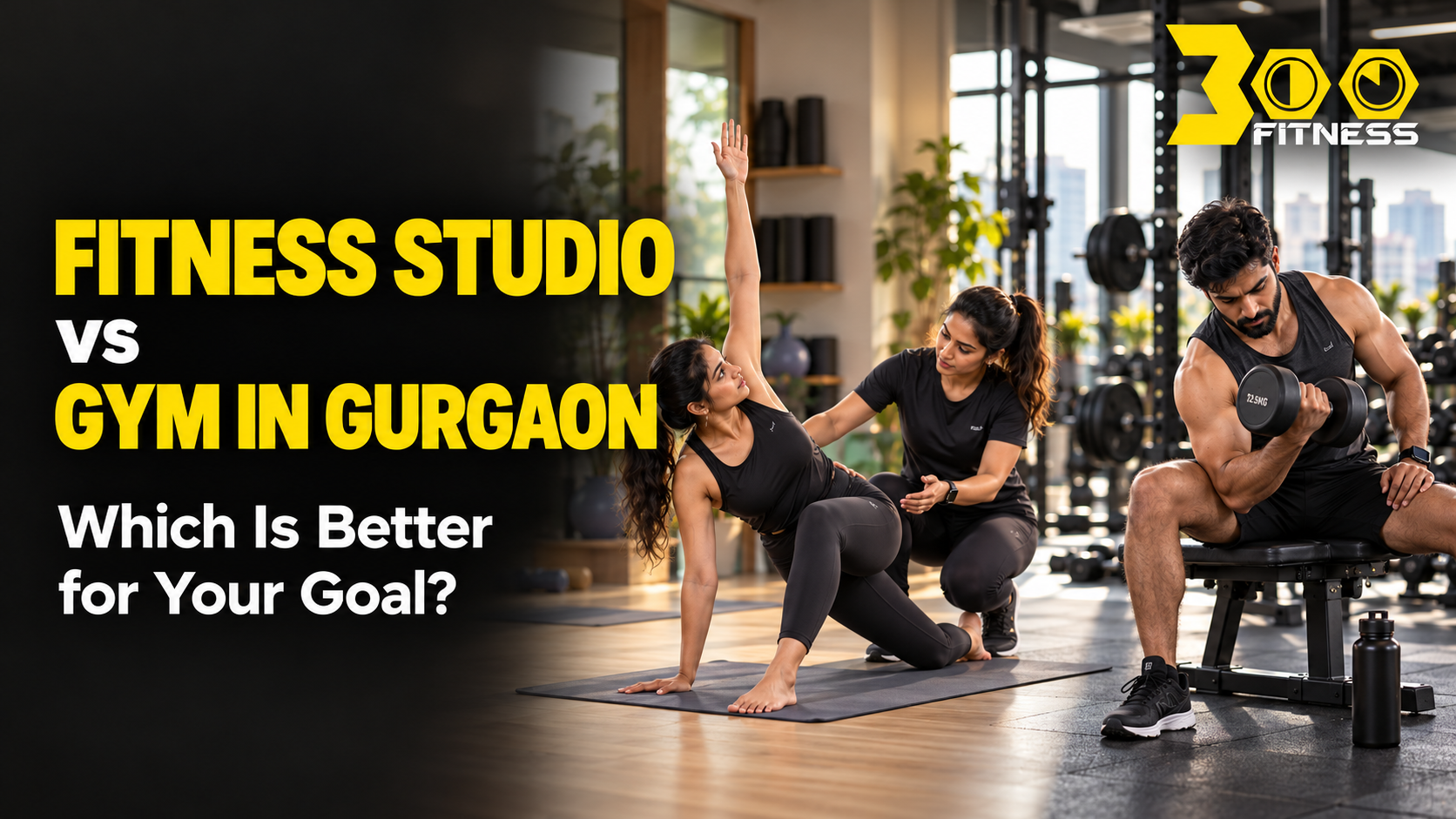
A fitness studio and a traditional gym solve different problems. A gym usually gives you broader equipment access, more flexibility to train independently and multiple workout options under one membership. A fitness studio usually focuses more narrowly on coached classes or a particular training style. The better option depends on whether you value flexibility and equipment variety or structured instructor-led sessions.
Searching for a fitness studio in Gurgaon can produce everything from yoga and Pilates studios to strength, HIIT, boxing and small-group training spaces.
That can make the decision confusing.
Should you join a specialised fitness studio?
Would a full gym give you more value?
Would you train more consistently in classes?
Or do you need enough equipment and flexibility to follow your own program?
India’s fitness market itself now distinguishes between value, premium and boutique fitness formats. Deloitte and the Health & Fitness Association describe boutique studios as more focused on niche, instructor-led formats such as HIIT, yoga, MMA and Pilates, while broader gym formats typically serve a wider range of training needs.
The decision therefore starts with one question:
How do you actually want to train?
Should You Join a Fitness Studio or a Gym?
Choose a fitness studio if you prefer scheduled, instructor-led workouts and are happy specialising in one or a few training styles. Choose a gym if you want broader equipment access, flexible workout timing, strength and cardio options, independent training and the ability to change your program over time. If you like both, look for a gym that combines open training with structured group workouts.
What Is a Fitness Studio?
A fitness studio is generally a smaller, more focused training facility.
Instead of trying to offer every possible form of exercise, it may specialise in one area or a narrow group of related formats.
Examples can include:
- yoga;
- Pilates;
- HIIT;
- boxing;
- functional training;
- dance fitness;
- indoor cycling;
- strength-focused small-group training.
Boutique fitness studios tend to differentiate themselves through specialisation, instructor-led programming and a more structured class environment.
You usually arrive for a specific session.
The instructor controls:
- the workout format;
- exercise sequence;
- session timing;
- class pace.
For someone who dislikes planning workouts independently, that can be a major advantage.
What Is a Traditional Gym?
A gym generally gives members broader access to exercise equipment and more control over how and when they train.
Depending on the facility, that can include:
- resistance machines;
- free weights;
- cardio equipment;
- functional-training areas;
- group classes;
- personal training.
You may train completely independently.
Or you may use a workout plan or personal trainer.
Or you may combine gym-floor sessions with group classes.
The defining advantage is usually flexibility.
Instead of booking one specific workout format, you have more freedom to decide what type of training you need that day.
Fitness Studio vs Gym: The Biggest Differences
Fitness Studio vs Gym at a Glance
The exact services vary by facility, but these differences can help you decide which model fits your training style.
| Factor | Fitness Studio | Traditional Gym |
|---|---|---|
| Training Style | Usually specialised | Usually broader |
| Workout Structure | Mostly instructor-led | Independent, coached or class-based |
| Equipment | Selected for the studio format | Usually wider resistance and cardio selection |
| Timing | Often tied to class schedules | Usually more flexible for independent workouts |
| Coaching | Built into most classes | Varies from floor guidance to paid PT |
| Community | Often strong because members attend the same sessions | Depends on classes and member behaviour |
| Program Variety | Usually narrower | Usually broader |
| Best For | People who enjoy structured classes | People who value flexibility and variety |
1. Choose Based on Your Goal First
The correct facility depends heavily on your objective.
For General Fitness
Either model can work.
A studio can give you regular coached sessions.
A gym can allow you to combine:
- resistance training;
- cardio;
- classes;
- independent workouts.
The better choice may simply be whichever routine you can maintain.
For Strength and Muscle Gain
A traditional gym can have an advantage when it provides a broader resistance-training setup.
You may need access to:
- different resistance machines;
- free weights;
- benches;
- cable stations;
- exercises that allow progressive loading.
Some specialised strength studios also provide excellent resistance training, so the word “studio” itself should not decide the issue.
Inspect the equipment and programming.
For Yoga or Pilates
A specialised studio may make more sense if this is the main form of exercise you want.
A studio centred around one discipline can provide:
- specialised equipment where relevant;
- instructors focused on that format;
- frequent classes.
For Group Fitness
A studio can be attractive if you prefer every workout to be instructor-led.
But many full gyms now also offer multiple group workout formats.
That creates a useful middle ground.
2. Think About How Much Structure You Need
This may be the biggest difference.
Fitness Studios Usually Provide More Automatic Structure
You book the class.
You arrive.
The workout has already been created.
You follow the instructor.
That eliminates decisions.
For someone who repeatedly enters a gym and wonders what to do, this can be helpful.
Gyms Require More Independence Unless Support Is Provided
If you train alone, you need some idea of:
- what exercises to perform;
- how many sets;
- how many repetitions;
- how to progress.
This is why workout planning becomes important.
A good gym should not necessarily force every member into personal training, but beginners should understand what support is available.
300 Fitness currently states that it offers personalised Workout Cards designed around goals such as weight loss, muscle building and general fitness, alongside trainer guidance for equipment use.
That kind of model combines gym flexibility with more structured planning.
3. Compare Equipment Based on What You Will Actually Use
Studios often use equipment selected specifically for their chosen training style.
That can be excellent if that style matches your goal.
A Pilates studio does not need a huge free-weight area to deliver Pilates.
A boxing studio does not need dozens of bodybuilding machines to deliver boxing sessions.
The problem appears when your goals expand.
Suppose you join a specialised studio primarily for group conditioning.
Six months later, you decide you also want to focus more seriously on strength.
You may need additional equipment or another membership.
A Broad Gym Gives You More Room to Change Goals
One membership may allow you to move between:
- strength;
- hypertrophy;
- cardio;
- classes;
- general conditioning.
That flexibility becomes valuable when your training evolves.
4. Compare Class Schedule vs Open-Gym Flexibility
A fitness studio can be convenient when class timing matches your schedule.
It becomes less convenient when it does not.
Imagine your preferred class is at 6:30 PM.
But your Gurgaon office frequently keeps you until 7 PM.
The quality of the class becomes irrelevant if you rarely attend.
Studios Suit People Who Like Fixed Appointments
A class can create accountability.
You know exactly when the workout starts.
Gyms Suit People With Variable Schedules
If your office timing changes frequently, being able to train independently at different times may be more practical.
For working professionals around Sector 48, Sector 49 and Sohna Road, this distinction can significantly affect consistency.
Want Gym Flexibility With Structured Workouts?
Visit 300 Fitness in Sector 49, Sohna Road and compare its gym-floor training, personalised Workout Cards and group workout options with the fitness studios on your shortlist.
5. Consider Coaching Attention
A specialised studio often centres the entire experience around an instructor.
That can make coaching feel more integrated into the session.
In a traditional gym, coaching may be divided into:
- general floor guidance;
- group classes;
- workout planning;
- personal training.
Neither system is automatically superior.
Ask how much individual attention you actually need.
Choose More Coaching If You Are a Beginner
Beginners may benefit from:
- exercise explanation;
- technique guidance;
- workout structure;
- feedback.
Choose More Independence If You Already Know How to Train
An experienced member may prefer equipment access and programming freedom over being coached through every session.
6. Fitness Studio vs Personal Trainer
These are also different products.
A fitness-studio class may include instructor guidance, but the instructor is still responsible for multiple people.
Personal training is usually more individual.
Studio Coaching
Typically follows one class format.
The instructor may provide:
- exercise cues;
- modifications;
- motivation;
- pacing.
Personal Training
Can be built specifically around:
- your goal;
- training level;
- exercise technique;
- progress;
- schedule.
If you need highly personalised coaching, compare personal training with the studio experience rather than assuming all instructor-led sessions provide the same level of individualisation.
7. Which Is Better for Beginners?
Both can work.
A beginner who dislikes making workout decisions may enjoy a structured studio.
A beginner who wants to learn strength training and gradually become independent may prefer a gym with:
- trainer guidance;
- workout planning;
- accessible equipment;
- progress reviews.
The most important thing is not the business model.
It is whether the facility has a clear beginner process.
Ask:
What happens during my first week?
If nobody can explain it clearly, keep comparing.
8. Which Is Better for Fat Loss?
Neither format automatically produces more fat loss.
A fitness studio may deliver high-energy group workouts.
A gym may allow you to combine resistance training and cardio.
Results still depend on the broader pattern of:
- exercise;
- nutrition;
- regular physical activity;
- recovery;
- consistency.
Do not choose based on claims such as:
“This workout burns more fat than a gym.”
That oversimplifies the issue.
Choose the environment in which you can maintain an appropriate training routine.
9. Which Is Better for Strength Training?
A traditional gym often provides more flexibility for progressive strength training because members can access equipment independently and control:
- exercise selection;
- resistance;
- sets;
- repetitions;
- rest periods.
A specialised strength studio can also be excellent if progressive resistance training is its core service.
The label matters less than the programming.
Ask:
- Can I progressively increase resistance?
- Can the program adapt as I improve?
- Is suitable equipment available?
- Can I track progress?
10. Which Is Better for Accountability?
Studios can have an advantage for people who benefit from scheduled sessions.
Booking a 7 PM class creates an appointment.
You either attend or miss it.
A traditional gym provides more flexibility, but that freedom requires more self-management.
You Can Add Accountability to a Gym
Options can include:
- a personal trainer;
- fixed workout days;
- scheduled classes;
- workout cards;
- progress reviews.
The real question is whether you need accountability built into the business model or whether you can create it yourself.
11. Compare Cost Based on What You Receive
Do not compare only monthly price.
A studio membership may include coached classes in every session.
A gym membership may provide broad equipment access while personal training costs separately.
These are different purchases.
Deloitte and HFA’s India fitness-market analysis identifies boutique studios as a distinct and rapidly growing segment characterised by niche, instructor-led formats and more personalised experiences.
The useful calculation is:
What am I paying for and how often will I use it?
Studio Value Can Be Strong If
You attend classes frequently and value coaching.
Gym Value Can Be Strong If
You train several times per week and use:
- resistance equipment;
- cardio;
- classes;
- workout planning.
Either Can Be Poor Value
If you rarely go.
12. Do You Need Both?
Some people genuinely enjoy both models.
For example:
Gym: 3 strength sessions per week
Studio: 1 Pilates or boxing session per week
That can work.
But two memberships also mean two sets of fees.
Before buying both, check whether one facility already provides enough variety.
A gym offering both open-floor training and group workouts can reduce the need for multiple memberships.
What Does 300 Fitness Offer?
300 Fitness currently operates as a broader gym model rather than a single-format boutique studio.
Its official website lists:
- workout equipment;
- personalised Workout Cards;
- trainer guidance;
- group workout classes;
- nutrition counselling;
- monthly Fitness Assessment Tests.
Current group formats listed on the website include:
- HIIT;
- Strength Training;
- Yoga;
- Zumba;
- Bhangra;
- MMA.
The site also states that trial classes are available for prospective members.
This creates a hybrid decision for someone comparing a fitness studio with 300 Fitness.
You can use the broader gym equipment and personalised Workout Card while still accessing structured group workouts.
Whether that is more useful than a specialised studio depends on your main goal.
Fitness Studio vs Gym Decision Checklist
Which Option Fits You Better?
Use your actual training behaviour rather than the appearance of the facility to make the decision.
| If You Prefer… | Fitness Studio May Suit You | Gym May Suit You |
|---|---|---|
| Instructor-Led Training | Yes, usually the core model | Yes, if group classes or PT are available |
| Flexible Training Time | Less flexible if sessions require booking | Usually stronger |
| Wide Equipment Choice | Usually limited to the studio format | Usually stronger |
| Small-Group Atmosphere | Often stronger | Depends on classes |
| Independent Strength Training | Depends on the studio | Usually stronger |
| Specialised Training | Often stronger | Depends on gym services |
| Changing Goals Over Time | May require another studio or service | Usually more adaptable |
| Maximum Structure | Often stronger | Can be added through classes, PT or workout planning |
Questions to Ask a Fitness Studio Before Joining
Ask:
- What type of training does the studio specialise in?
- How many classes are available each week?
- What happens if I miss a booked class?
- How large are the classes?
- Can beginners join?
- How are exercises modified for different levels?
- Can I train independently outside class time?
- What equipment is available?
- How is progress measured?
- Does the membership cover all sessions?
Questions to Ask a Gym Before Joining
Ask:
- What equipment supports my goal?
- Will I receive a workout plan?
- What trainer guidance is included?
- Which group classes are included?
- Is personal training separate?
- How busy is the gym during my normal workout time?
- How is progress reviewed?
- Can I try the gym or a class first?
- What membership duration makes sense?
- What additional charges apply?
How to Decide in One Visit
If possible, experience both.
For a studio:
Take the actual class you expect to attend regularly.
For a gym:
Visit during the hours you expect to train and walk through the workout you would realistically perform.
Then compare:
- enjoyment;
- convenience;
- coaching;
- equipment;
- flexibility;
- cost;
- likelihood of returning.
Do not ask which facility impressed you more.
Ask:
Which one can I realistically use for the next six months?
Final Takeaway
A fitness studio is not a smaller version of a gym.
And a gym is not simply a larger studio.
They provide different fitness experiences.
Choose a fitness studio when you value:
- specialisation;
- scheduled classes;
- instructor-led sessions;
- small-group structure.
Choose a gym when you value:
- broader equipment;
- workout flexibility;
- independent training;
- the ability to combine strength, cardio and classes.
If you want elements of both, compare gyms that combine open-floor training with structured group workouts and personalised programming.
Try the Training Style Before You Commit
Visit 300 Fitness in Sector 49, Sohna Road and compare its open gym training, personalised Workout Cards and group workout options with the fitness studios on your shortlist.
Visit 300 FitnessFrequently Asked Questions
What is the difference between a fitness studio and a gym?
A fitness studio usually specialises in one or a few training formats and relies heavily on instructor-led sessions. A gym generally offers broader equipment access, flexible independent training and potentially group classes and personal training.
Is a fitness studio better than a gym?
Not universally. Studios can be better for people who want specialised, instructor-led sessions. Gyms can be better for people who want broader equipment and flexible training.
Is a fitness studio good for beginners?
Yes, especially if classes provide clear instruction and appropriate exercise modifications. Beginners can also do well in gyms that provide structured workout planning and trainer guidance.
Is a gym better for strength training?
A gym often provides more equipment and flexibility for progressive strength training, but a specialised strength studio can also be effective if its equipment and programming support progression.
Are fitness studios more expensive than gyms?
They can be, particularly when memberships include small-group coaching or specialised instruction. Compare the actual services and number of sessions you expect to use rather than price alone.
Is a fitness studio good for weight loss?
A studio can support regular exercise, but no facility format guarantees weight loss. Results also depend on nutrition, activity, consistency and other individual factors.
Which is better for working professionals?
It depends on the schedule. Fixed studio classes can create accountability, while a gym may provide more flexibility when office hours change frequently.
Can I combine gym workouts with fitness classes?
Yes. Many people combine independent resistance training with group fitness. Some gyms provide both under one membership, reducing the need for separate memberships.
Does 300 Fitness offer group fitness classes?
Yes. The current 300 Fitness website lists HIIT, Strength Training, Yoga, Zumba, Bhangra and MMA among its group workout formats.
Is 300 Fitness a fitness studio?
300 Fitness operates as a broader gym rather than a single-format boutique fitness studio. Its official website lists gym equipment, personalised Workout Cards, group classes, trainer guidance, nutrition counselling and fitness assessments.