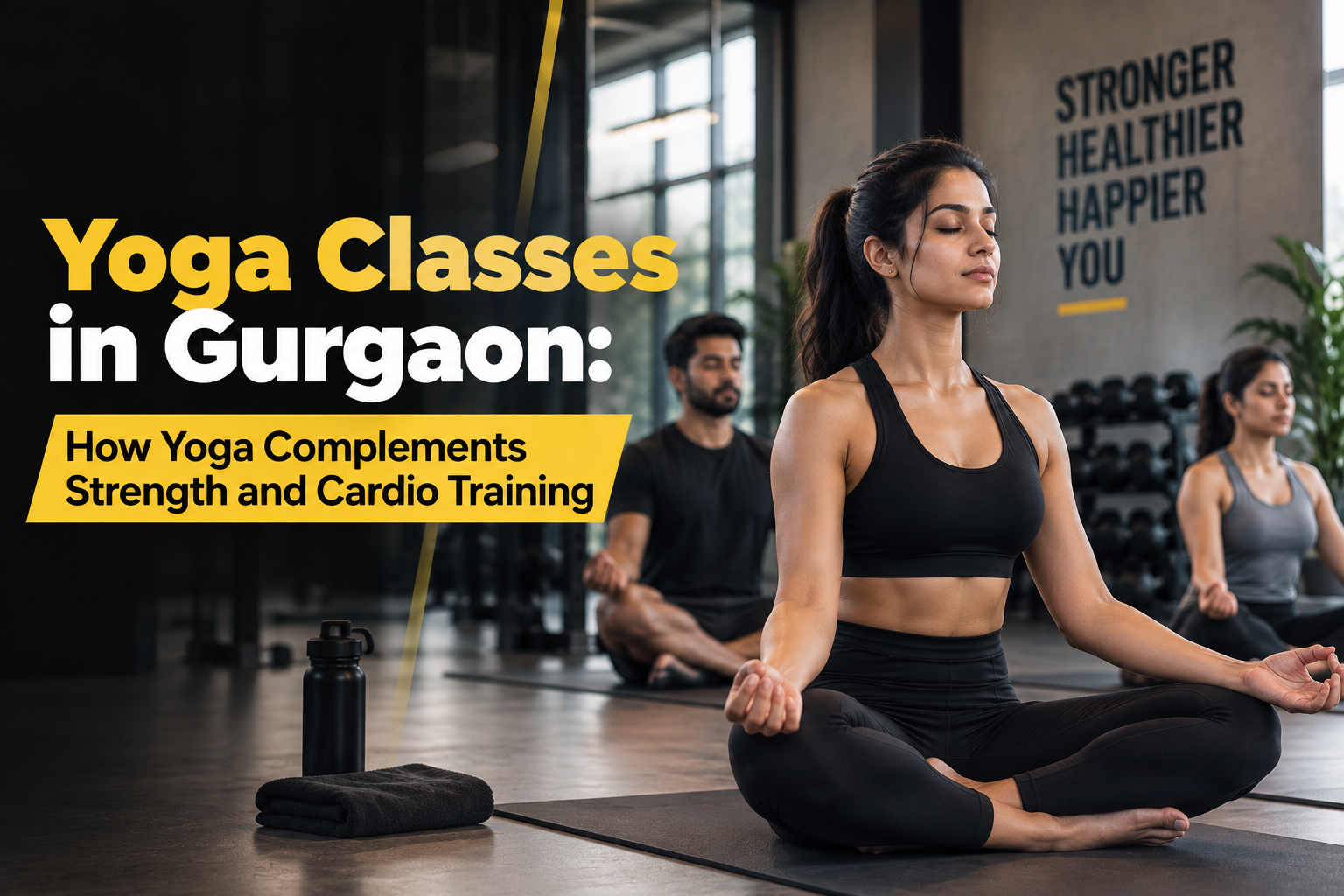
Yoga does not have to replace your gym workouts.
For many people, it works better as a complement to strength training and cardio, adding controlled movement, flexibility, balance and a different type of physical challenge to the week.
If you already lift weights or perform cardio, yoga can fill gaps that your normal routine may not directly focus on. If you are a beginner, it can also be a structured way to practise body awareness and movement control.
For someone comparing yoga classes in Gurgaon, particularly around Sector 49, Sohna Road, Omaxe The Nile or South City 2, the most useful question is not whether yoga is better than the gym.
Ask how yoga fits with the training you already do.
How does yoga complement gym training?
Yoga can complement strength and cardio by adding flexibility work, balance, controlled movement and body awareness to the week. It does not need to replace resistance or aerobic training. Many gym members can use one or two yoga sessions alongside regular strength and cardio workouts, with frequency adjusted according to class intensity, recovery and individual goals.
What Role Can Yoga Play in a Gym Routine?
Yoga and gym training are often presented as two completely separate choices.
That is unnecessary.
Strength training develops your ability to produce force against resistance.
Cardio develops aerobic fitness and your ability to sustain physical activity.
Yoga can add another set of qualities, depending on the style and session:
- flexibility;
- balance;
- controlled movement;
- body awareness;
- coordination;
- breathing control;
- mobility through selected positions.
This makes yoga particularly useful as part of a mixed weekly routine.
For example, someone who spends most gym sessions lifting weights may enjoy having one day where the focus shifts away from external resistance and towards controlled movement.
Someone who mainly runs or cycles may use yoga to include movement through ranges that are not emphasised during repetitive cardio.
A beginner may simply enjoy having a structured instructor led session where the goal is not to lift heavier or move faster.
Research does not support treating yoga as a cure all, but credible reviews do suggest benefits for physical qualities such as balance. A 2025 systematic review of 18 randomised controlled trials found that yoga improved balance in healthy participants, although the authors rated the certainty of evidence as low and noted substantial differences between studies.
Yoga and Flexibility
Flexibility is one of the most common reasons people start yoga.
It refers broadly to the available range of motion around joints and the ability of muscles and other tissues to lengthen enough for particular movements.
Yoga classes often include positions that place different muscle groups through sustained or repeated ranges of motion.
Over time, that can improve flexibility in areas that are regularly trained.
A recent systematic review examining yoga and spinal or shoulder mobility reported potential improvements in spinal flexibility and mobility, although the included studies covered different populations and yoga protocols.
The important word is potential.
Yoga should not be sold as a guaranteed fix for every mobility problem.
If you cannot reach a certain position because of your individual anatomy, an injury or another limitation, doing more stretching is not automatically the solution.
Flexibility Is Not the Same as Mobility
These terms are often used as if they mean exactly the same thing.
They are related, but not identical.
Flexibility generally describes how much range is available.
Mobility includes your ability to actively control movement through that range.
For a gym member, both can matter.
Having enough range to perform an exercise is useful.
Being able to control that range while squatting, pressing, lunging or hinging is even more useful.
The 300 Fitness Foundation Builder program currently includes mobility and flexibility work alongside foundational strength training and core stability.
That is a good example of how movement work can sit alongside resistance training rather than competing with it.
Yoga and Balance and Movement Control
Balance is another area where yoga can complement a gym routine.
Many yoga positions require you to:
- control your body over a smaller base of support;
- shift weight from one leg to another;
- stabilise your trunk;
- coordinate several joints at once;
- hold a position without relying on external support.
A 2025 systematic review of healthy individuals found a beneficial effect of yoga on balance, although the evidence was considered low certainty because the studies varied in yoga style, duration and assessment methods.
The US National Center for Complementary and Integrative Health also notes that research suggests yoga may support balance as part of general wellness.
You can review its evidence summary at:
NCCIH Yoga: Effectiveness and Safety
https://www.nccih.nih.gov/health/yoga-effectiveness-and-safety
For a gym member, this does not mean you should replace squats or strength exercises with balance poses.
Think of yoga as another movement environment.
Strength training may ask you to control an external load.
Yoga often asks you to control your own body position.
Both can have a place.
Want to Add Yoga Without Dropping Your Gym Routine?
Visit 300 Fitness in Sector 49, Sohna Road and discuss how mobility, group workouts and structured gym training can fit together in your weekly plan.
Yoga Alongside Strength Training
Yoga and strength training can work well together because they emphasise different physical qualities.
A strength session may focus on:
- squats;
- presses;
- rows;
- deadlift variations;
- resistance machines;
- progressive overload.
A yoga session may focus more heavily on:
- movement control;
- positions through different ranges of motion;
- balance;
- flexibility;
- breathing;
- lower intensity movement.
They can overlap too.
Some yoga positions require meaningful muscular effort, especially for people who are new to them.
But yoga is not generally the most efficient replacement for progressive resistance training if your main goal is to maximise strength or muscle gain.
A 2025 expert consensus on stretching concluded that stretching can improve range of motion, but resistance training remains a more efficient primary strategy for increasing strength and muscle mass.
This is why the two can complement each other.
You do not need yoga to do the job of strength training.
You can use yoga for the qualities it trains well.
Can You Do Yoga and Strength Training on the Same Day?
Yes, depending on the intensity of both sessions.
A practical approach is to decide which activity is the priority that day.
If your primary session is heavy strength training, you may prefer:
- A normal warm up.
- Your main strength workout.
- A shorter, comfortable yoga or mobility session afterwards.
Another option is to separate the sessions by several hours.
If the yoga class itself is physically demanding, treat it as training rather than assuming it is recovery.
What About Yoga Before Lifting?
A short movement based warm up may work well before strength training.
A long session dominated by prolonged static stretching immediately before heavy or explosive lifting may be less useful.
A 2025 international expert consensus recommended avoiding prolonged static stretching of more than about 60 seconds per muscle immediately before maximal or explosive strength efforts, while shorter stretching and dynamic warm up methods were less concerning.
That does not mean yoga before weights is forbidden.
It means timing and intensity matter.
Yoga Alongside Cardio and Conditioning
Cardio training includes activities such as:
- brisk walking;
- treadmill work;
- running;
- cycling;
- rowing;
- dance fitness;
- conditioning circuits.
Yoga provides a different type of stimulus.
If cardio sessions are repetitive, yoga can introduce different movement directions and positions into the week.
For example:
Runner or treadmill user: Yoga may add more deliberate flexibility and balance work.
Cycling focused member: Yoga may provide movement through positions that differ from prolonged seated cycling.
HIIT participant: A lower intensity yoga session may give the week more variation.
Again, yoga should not automatically be labelled a recovery workout.
Some yoga styles can be challenging.
Choose the format based on what the rest of your week already contains.
Yoga, Strength and Cardio: How They Complement Each Other
Use Each Training Method for What It Does Best
A balanced fitness week can include all three rather than forcing one method to replace the others.
Is Yoga Enough for Strength and Fitness?
It depends on your goal.
Yoga can be physically demanding and some styles can challenge muscular strength.
But if your goal is specifically to improve maximum strength or develop muscle through progressive overload, structured resistance training is still more direct.
Likewise, yoga sessions can elevate your heart rate, but they should not automatically be assumed to replace all aerobic activity.
WHO recommends adults accumulate 150 to 300 minutes of moderate intensity aerobic activity per week, or an equivalent vigorous amount, plus muscle strengthening activity involving major muscle groups on at least two days.
The official physical activity guidance can be reviewed here:
A complete fitness routine can therefore include yoga without making yoga responsible for every aspect of fitness.
How Often Should Gym Members Do Yoga?
There is no universal frequency.
For many gym members, one or two yoga sessions per week can be a practical place to start.
A beginner might use:
- two strength sessions;
- one yoga class;
- regular walking or cardio.
Someone training more frequently might use:
- three strength sessions;
- one cardio session;
- one yoga class.
Another person may enjoy two yoga classes and two gym sessions.
The important variables are:
- class intensity;
- your main goal;
- total weekly training;
- recovery;
- how much time you realistically have.
Do not add yoga to an already overloaded schedule simply because more exercise sounds better.
Example Weekly Yoga, Strength and Cardio Plan
| Day | Activity |
| Monday | Full Body Strength |
| Tuesday | Yoga |
| Wednesday | Walking or Moderate Cardio |
| Thursday | Full Body Strength |
| Friday | Rest or Light Activity |
| Saturday | Cardio or Group Fitness |
| Sunday | Yoga or Rest |
This is an example, not a prescription.
A person training near Sohna Road after work may prefer shorter weekday sessions and a longer yoga class on the weekend.
A South City 2 resident may find an early morning class easier to maintain.
The best weekly layout is the one that works in normal life.
Should Yoga Be Before or After Strength Training?
If both happen in one session, strength first is often practical when strength is the main priority.
A simple structure could be:
Short warm up → strength training → optional yoga or flexibility work
If yoga is the priority, attend the yoga class as its own session and schedule demanding strength work at another time.
The bigger point is not to follow one rigid order.
Consider how tiring the yoga session is and what you need to perform well in afterwards.
A gentle class and a demanding power yoga session should not be treated as the same thing.
How Beginners Should Choose Yoga Classes in Gurgaon
A beginner should not choose a yoga class only because it appears at the top of a search result.
Check the actual class.
Ask:
- Is it beginner friendly?
- What style of yoga is taught?
- Is the class gentle or physically demanding?
- Are positions modified for different ability levels?
- Does the instructor explain technique?
- How long is the session?
- Does the timetable fit your week?
- Is it intended as general yoga or a more intense fitness class?
Local search results for yoga classes in Gurgaon currently emphasise location, instructor access, morning and evening schedules, home sessions and different yoga formats.
Those details matter, but if you already go to a gym, also ask whether the yoga schedule complements your existing training.
A class you can attend consistently around Sector 49, Omaxe The Nile or South City 2 can be more useful than a theoretically ideal class that requires an inconvenient Gurgaon commute.
Yoga and #300MinutesPerWeek
The 300 Fitness #300MinutesPerWeek philosophy works well with a mixed training approach.
Those minutes do not all have to come from weights or treadmill cardio.
For example:
| Activity | Example Weekly Time |
| Strength Training | 2 × 50 minutes |
| Yoga | 2 × 50 minutes |
| Walking or Cardio | 5 × 20 minutes |
| Total | 300 minutes |
This is only an illustration.
The actual mix should reflect your goals.
Someone focused on muscle gain may dedicate more of the week to resistance training.
Someone focused on general movement may include more yoga, walking and group exercise.
The useful idea is to build a repeatable week of physical activity.
How Yoga Fits the 300 Fitness Approach
300 Fitness is located at Omaxe Gurgaon Mall in Sector 49, Gurugram, and its current website emphasises structured workout planning, group classes, mobility and flexibility work, and making fitness easier to integrate into everyday life.
You can explore the 300 Fitness services and 300 Fitness approach.
If your current gym routine already includes strength and cardio, yoga can be considered an additional tool rather than a replacement.
Use it where it helps.
Build flexibility.
Practise balance.
Move differently.
Then return to your strength and cardio sessions with a weekly routine that feels more complete.
Build a Better Weekly Mix of Strength, Cardio and Movement
Visit 300 Fitness at Sector 49, Sohna Road and discuss how yoga, mobility work and structured gym training can fit your goals and weekly routine.
Visit 300 FitnessFrequently Asked Questions
Can I do yoga and gym workouts on the same day?
Yes. Yoga and gym training can be done on the same day if the total workload suits your fitness level. If strength is the priority, complete your main strength work while fresh and use gentler yoga or mobility work afterwards, or separate the two sessions by several hours.
Is yoga enough for strength and fitness?
Yoga can develop useful strength, balance and movement control, but it is not necessarily a complete replacement for progressive resistance training or aerobic exercise. A balanced routine can include yoga, strength training and cardio.
How often should beginners attend yoga classes?
One or two sessions per week can be a practical starting point for many beginners. Frequency should depend on class intensity, other workouts, recovery and how well the schedule fits the person’s lifestyle.
Does yoga help flexibility?
Yoga can help improve flexibility because many sessions involve controlled positions through different ranges of motion. Research also suggests some yoga interventions can improve flexibility and mobility, although outcomes vary by yoga style and population.
Should I do yoga before or after strength training?
If your main goal that day is strength training, doing the main lifting session first is often practical. Short mobility work can be included before training, while longer or gentler yoga can be scheduled afterwards or separately.
Can yoga improve balance?
Research suggests yoga can improve balance in healthy adults, although study methods and yoga styles vary. Balance based positions can challenge body control and stability in ways that complement traditional gym exercises.
Can I do yoga on a rest day?
Yes, if the session is light enough for your recovery needs. Remember that some yoga formats can be physically demanding, so a hard class should be treated as training rather than automatically considered rest.
Is yoga good after cardio?
Yoga can be included after cardio if the session is comfortable and does not add more fatigue than you can recover from. You can also place yoga on a separate day if you prefer a longer class.
Do I need to be flexible before joining yoga?
No. You do not need to be flexible before starting yoga. Flexibility can be one of the qualities you develop through practice. Beginners should choose a class that allows positions to be adjusted to their current ability.
Where can I find yoga classes in Sector 49 Gurgaon?
300 Fitness is located in Sector 49 at Omaxe Gurgaon Mall on the Sohna Road corridor. If you want to add yoga or mobility focused training to your current gym routine, contact the team directly to confirm the current group class schedule.