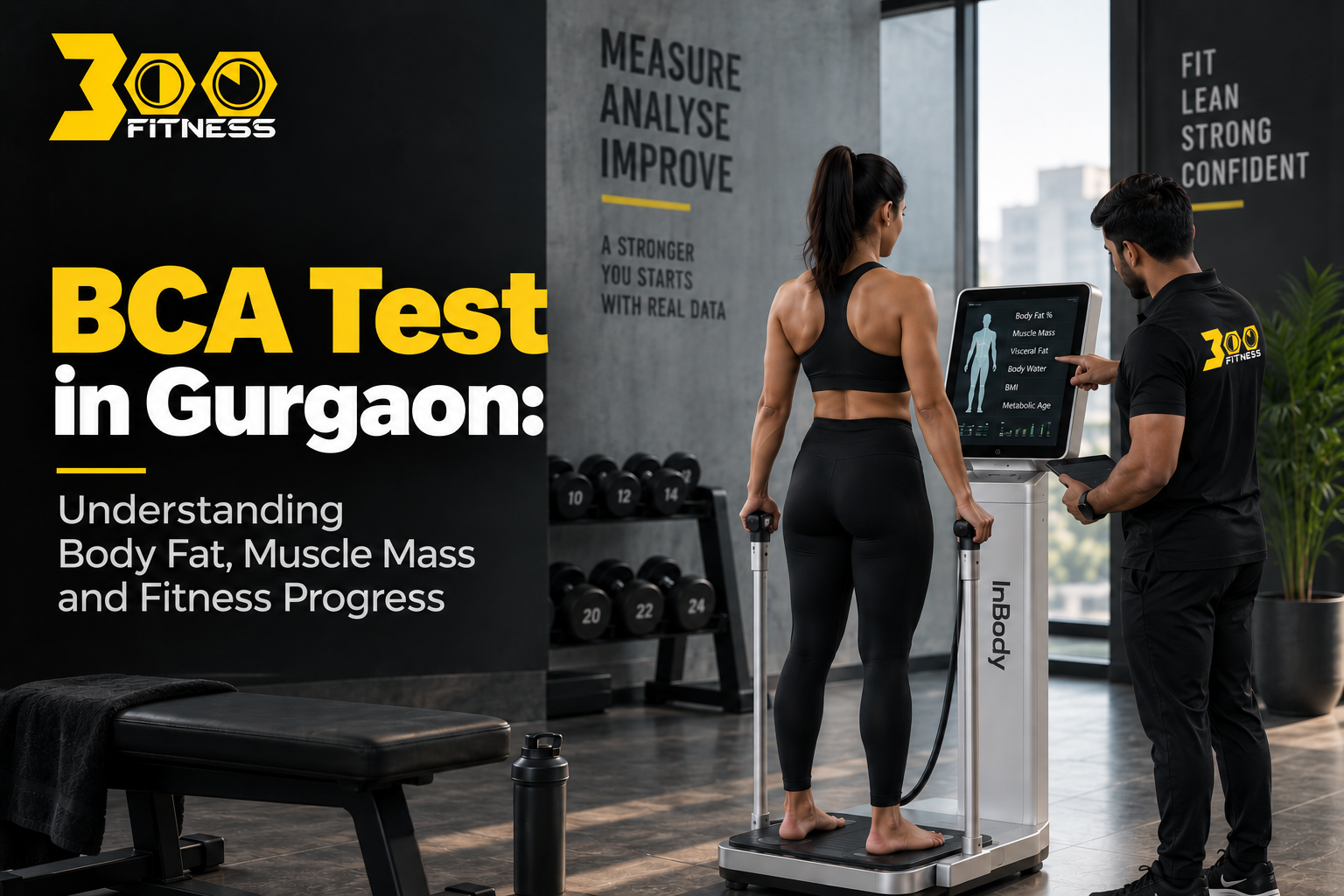
A BCA test in a gym setting usually means Body Composition Analysis, an assessment that estimates how your body weight is distributed across metrics such as body fat and muscle-related mass. Depending on the device, a report may also show body water, visceral-fat indicators, resting metabolism or body age.
The useful part is not collecting as many numbers as possible.
It is understanding which numbers matter for your goal, repeating measurements under similar conditions and using the trend alongside your strength, stamina, workout consistency and nutrition.
For someone searching for a BCA test in Gurgaon, particularly around Sector 49, Sohna Road, South City 2 or Omaxe The Nile, the assessment is most valuable when it becomes part of a structured fitness review rather than a one-time score.
What does a BCA test tell you?
A BCA test estimates body-composition metrics that may include body fat, muscle-related measurements, body water and other device-specific indicators. It can provide more fitness context than body weight alone, but the values are estimates rather than medical diagnoses. For progress tracking, use the same method under similar conditions and interpret trends together with workout performance, strength and consistency.
What Does BCA Mean in a Gym Setting?
In most gym and fitness contexts, BCA means Body Composition Analysis.
Instead of measuring only total body weight, a body composition assessment attempts to estimate how that weight is divided between different types of tissue or body compartments.
Depending on the technology, the report may include:
- total body weight;
- body fat percentage;
- fat mass;
- fat-free mass;
- skeletal-muscle percentage or another muscle-related estimate;
- total body water;
- visceral-fat indicator;
- resting metabolism;
- BMI;
- body age.
Not every BCA machine reports the same metrics.
That point is easy to overlook.
A body composition test in Gurgaon at one facility may produce a different report from a test performed elsewhere because the machines, measurement methods and proprietary equations may differ.
Bioelectrical impedance analysis, commonly called BIA, is one widely used body-composition method in fitness settings. It estimates body composition using the body’s electrical impedance together with variables such as height, weight, age and sex. Scientific reviews describe it as accessible and useful, while also noting that device technology and prediction methods influence interpretation.
Read the overview of BIA technology on PubMed.
What Metrics May Appear on a BCA Report?
A long report can look technical, but most gym members only need to understand a few core metrics.
| Metric | What It Usually Represents | How to Use It |
| Body Weight | Your total measured mass | Useful baseline, but does not explain what changed |
| Body Fat Percentage | Estimated percentage of total weight that is fat | Track cautiously as a trend |
| Fat Mass | Estimated total mass attributed to body fat | Useful when assessing changes over time |
| Fat-Free Mass | Everything in body mass except fat | Includes more than skeletal muscle |
| Skeletal Muscle | Device-specific estimate of skeletal muscle or percentage | Compare using the same method |
| Body Water | Estimated water content | Can help explain why measurement conditions matter |
| Visceral-Fat Indicator | Device-generated estimate on some systems | Do not treat as a diagnosis |
| Resting Metabolism | Estimated energy requirement at rest | Formula and method depend on device |
| Body Age | Device-generated comparison metric | Use as a reference, not a medical age |
Do Not Assume Every Machine Measures the Same Thing
A device may display “muscle mass,” while another displays “skeletal muscle percentage.”
Those are not automatically the same metric.
Even products from the same manufacturer can report different combinations of measurements. For example, Omron’s Indian HBF-375 product reports skeletal-muscle percentage but not skeletal-muscle mass.
That is why a muscle mass test in Gurgaon should begin with a simple question:
What exactly does this device report?
Body Fat and Muscle Mass Explained
Body fat and muscle are usually the two BCA metrics that gym members care about most.
What Is Body Fat Percentage?
Body fat percentage is an estimate of the proportion of total body weight represented by fat.
For example, two people can have exactly the same body weight but very different estimated body-fat percentages.
That is one reason body weight alone cannot fully describe a person’s body composition.
But do not treat a single body-fat number as a verdict.
The useful questions are:
- Was the measurement taken consistently?
- Is the trend moving over time?
- Is your training performance improving?
- Does the trend match the goal you are working towards?
What Is Muscle Mass?
Muscle-related measurements attempt to estimate the amount or proportion of muscle tissue in the body.
For someone following strength training, this can be a useful additional marker.
But estimated muscle should be interpreted alongside actual gym performance.
If you are:
- lifting more weight;
- completing more repetitions;
- improving technique;
- progressing your workout consistently;
those performance improvements matter too.
A machine result should support the training conversation, not replace it.
Can You Lose Fat and Gain Muscle Without a Big Scale Change?
It is possible for changes in fat and muscle-related mass to partly offset one another on the weighing scale.
That is why tracking only body weight can sometimes make fitness progress look smaller than it really is.
Still, BCA estimates contain measurement error.
Use several indicators together rather than assuming every change on the report represents an exact tissue change.
300 Fitness currently includes Body Composition Analysis and Fitness Assessment Tests within its membership journey, along with personalised workout cards and monthly fitness reviews. The site’s FAQ also says monthly assessments can be used to review changes in muscle mass, fat percentage and overall fitness.
You can review the 300 Fitness services for the current membership structure.
Why a BCA Test Can Be More Useful Than Daily Weighing
Daily weight can fluctuate.
A BCA report will not remove every source of variation, but it can widen the discussion beyond “Did I lose weight?”
Suppose your goal is fat loss.
A useful review may look at:
- weight trend;
- estimated body-fat trend;
- strength performance;
- weekly activity;
- nutrition consistency.
For muscle gain, you might review:
- body-weight trend;
- muscle-related estimate;
- strength progression;
- training volume;
- recovery;
- nutrition.
For general fitness, body composition may not even be the most important metric.
You may care more about:
- stamina;
- strength;
- mobility;
- workout consistency;
- energy during training.
BCA is useful because it adds information, not because every fitness goal must revolve around body fat.
Want a Better Fitness Baseline Than Weight Alone?
Visit 300 Fitness in Sector 49, Sohna Road to discuss body composition, fitness assessment and how the results can connect with your workout plan.
What Body Age Means and Does Not Mean
Body age is generally a device-generated comparison metric. It is not your biological age, medical age or a prediction of how long you will live.
This term is especially important to explain because it sounds more medically significant than it really is.
Different manufacturers can calculate age-related fitness metrics differently.
For example, Omron explains that its Body Age metric is calculated using factors including weight, body-fat percentage, skeletal-muscle percentage and resting metabolism to provide a comparison with average values for an actual age.
Manufacturer reference:
A Lower Body Age Is Not a Medical Certificate
If a machine reports a body age of 28 when your chronological age is 35, that does not prove your organs, cardiovascular system or overall health are biologically seven years younger.
Likewise, a higher result does not diagnose poor health or disease.
Treat it as:
a simple device-specific fitness reference
rather than:
a clinical health outcome.
Why the Metric Can Still Be Useful
Body age can sometimes make a report easier for non-technical users to understand.
If the same device produces a changing result alongside improved strength, fitness habits and body-composition trends, it can be an additional motivational reference.
It should never be the only number you track.
How Accurate Is a BCA Test?
The answer depends on the technology.
Gym body-composition assessments are usually practical estimates, not laboratory-perfect measurements.
If the device uses BIA, results are influenced by:
- the machine;
- prediction equations;
- hydration;
- recent food intake;
- recent exercise;
- body position;
- testing conditions.
The NIH’s technology assessment on bioelectrical impedance concluded that the method can be useful for body-composition analysis, but measurements are affected by hydration, food and drink, recent physical activity, temperature and other procedural variables.
Source:
This gives you a better way to think about “accuracy.”
Instead of asking:
Is this number perfectly accurate?
Ask:
Can I take repeat measurements consistently enough to identify a useful trend?
How to Prepare for Repeatable Measurement
The exact preparation instructions should come from the facility and the device being used.
For trend tracking, consistency matters.
If your first test happens early in the morning before training and your second happens after a hard evening workout and a large meal, the comparison becomes harder to interpret.
Some manufacturers specifically recommend taking body-composition measurements at a consistent time and before exercise, eating or drinking when practical.
Use this checklist as a general comparison framework, not as a replacement for the device’s instructions.
BCA Repeat-Measurement Checklist
Keep the testing setup as similar as practical so changes are easier to interpret.
What Should You Avoid Before a Body Composition Test?
Follow the instructions provided for the exact machine being used.
As a general rule for BIA-based assessments, avoid creating obviously different conditions between repeat tests.
That can mean avoiding:
- a demanding workout immediately beforehand;
- unusually large meals immediately beforehand;
- unusual changes in hydration;
- comparing one well-rested test with another taken after heavy exercise.
Some manufacturers provide more specific restrictions, but those vary by device.
Do not assume a generic internet checklist overrides the protocol for the machine actually being used.
Using BCA Results With a Workout Plan
A BCA report becomes useful when it leads to a better training decision.
If Your Goal Is Fat Loss
You might combine:
- body-fat trend;
- total body-weight trend;
- strength progression;
- weekly activity;
- nutrition consistency.
The objective is not to reduce every number.
Preserving or developing muscle while improving fitness may matter too.
If Your Goal Is Muscle Gain
Review:
- muscle-related estimate;
- body-weight trend;
- strength progression;
- training volume;
- recovery;
- nutrition.
Do not increase food intake aggressively just because one test shows a small change.
Look at several weeks of information.
If Your Goal Is General Fitness
Your BCA numbers may be secondary.
Track:
- strength;
- stamina;
- mobility;
- workout consistency;
- body composition where useful.
You do not need a body-fat target to justify becoming fitter.
BCA Results Should Connect With Fitness Assessment
Body composition tells you about estimated composition.
It does not tell you everything about physical fitness.
A person can have a particular body-fat percentage and still differ dramatically from another person in:
- muscular strength;
- cardiovascular endurance;
- balance;
- mobility;
- exercise technique;
- training history.
That is why BCA works better alongside a broader fitness assessment in Gurgaon.
The current 300 Fitness membership journey includes Body Composition Analysis, Fitness Assessment Tests, personalised workout cards and monthly reviews.
That allows body-composition data to support a workout plan rather than becoming the entire goal.
Explore the 300 Fitness Fit School for the brand’s broader structured-training approach.
How Often Should You Repeat a BCA Test?
There is no universal ideal interval.
Testing every day is unlikely to provide useful information for normal gym progress because short-term changes and measurement noise can distract from the long-term trend.
300 Fitness currently states that it conducts monthly Fitness Assessment Tests for progress tracking.
A monthly review can be practical because it creates enough distance between tests to discuss:
- training adherence;
- strength progression;
- body-composition trends;
- nutrition consistency;
- changes to the workout card.
Still, a BCA does not have to be repeated at every review if it will not change a decision.
BCA Test in Gurgaon: What Should You Ask Before Booking?
Current Gurgaon fitness search results commonly position BCA testing alongside workout plans, diet guidance and fitness profiling.
The useful differentiator is not simply whether a gym has a BCA machine.
Ask whether the numbers are explained properly.
Use these questions:
- What does BCA mean at this facility?
- Which device or measurement method is used?
- Which metrics appear on the report?
- Does the report include body age?
- Is muscle reported as mass, percentage or another metric?
- How should I prepare before testing?
- Will repeat tests use the same device?
- How will the results influence my workout plan?
- Are fitness performance and strength also reviewed?
- Is the assessment clearly presented as a fitness tool rather than medical diagnosis?
For someone in South City 2 or near Omaxe The Nile, having assessment and regular training close to Sector 49 and Sohna Road can also make repeat reviews easier to maintain.
How a BCA Test Fits the 300 Fitness Approach
300 Fitness currently lists Body Composition Analysis as part of its membership journey, together with understanding fitness goals, Fitness Assessment Tests, workout cards, nutrition guidance and monthly fitness reviews.
That sequence matters.
A useful fitness process looks more like:
Assess → Set the goal → Build the workout plan → Train consistently → Review progress → Adjust
rather than:
Take a BCA test → Chase every number on the printout.
You can explore the 300 Fitness approach and current services for more context.
Measure Progress, Then Use the Numbers to Make Better Training Decisions
Visit 300 Fitness in Sector 49, Sohna Road to discuss BCA, fitness assessment, workout planning and how progress can be reviewed beyond body weight alone.
Visit 300 FitnessFrequently Asked Questions
What is a BCA test at a gym?
A BCA test generally means Body Composition Analysis. It estimates body-composition metrics such as body fat and muscle-related measurements, depending on the equipment used. It is intended to support fitness assessment and progress tracking rather than provide a medical diagnosis.
What is body age in a BCA report?
Body age is a device-generated comparison metric. Some devices calculate it from factors such as body composition and resting metabolism and compare the result with age-based reference data. It should not be interpreted as your true biological or medical age.
Can BCA measure muscle mass?
Some BCA devices estimate muscle mass, while others report skeletal-muscle percentage or another related metric. Check exactly what the machine provides because different body-composition terms are not always interchangeable.
Is a BCA test a medical test?
A gym BCA test should be treated as a fitness-assessment tool, not a medical diagnostic test. It may help with goal setting and fitness progress tracking, but medical concerns require appropriate clinical assessment.
What should I avoid before a body composition test?
Follow the instructions for the specific machine. For BIA-based testing, recent exercise, food intake and hydration can affect readings. Repeat tests are easier to compare when conditions such as time of day, hydration and recent activity are kept similar.
How accurate is a BCA test?
Accuracy depends on the technology and device. BIA-based machines provide estimates rather than perfect direct measurements. Their practical value is often greater for consistent trend tracking than for treating a single reading as exact.
How often should I repeat a BCA test?
There is no universal interval. Planned testing every few weeks or as part of a structured fitness review is generally more useful than testing constantly. 300 Fitness currently uses monthly fitness reviews within selected membership journeys.
Can a BCA test help with fat-loss planning?
It can add useful information by estimating body-fat and muscle-related trends. The result should be combined with body-weight trends, training performance, activity and nutrition rather than being used alone.
Can a BCA test help track muscle gain?
Yes, if the device provides a relevant muscle estimate. However, combine that estimate with actual strength progression, workout performance and body-weight trends because measurement error can affect individual readings.
Where can I get a BCA test in Sector 49 Gurgaon?
300 Fitness in the Sector 49 and Sohna Road area includes Body Composition Analysis within its current membership journey. Contact the gym directly to confirm the assessment process and what is included in the relevant membership option.