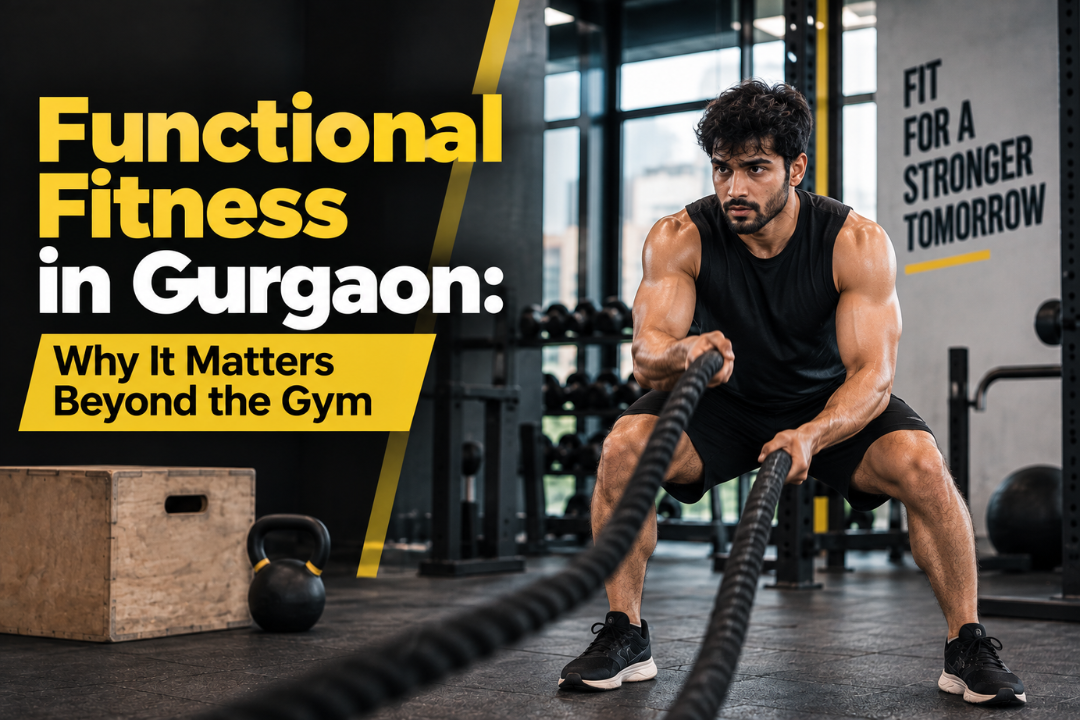
Functional fitness is training that helps your body become stronger and more capable in movement patterns you use in everyday life, such as squatting, bending, pushing, pulling, carrying, rotating and moving from one position to another.
That is the simplest way to understand it.
A functional workout is not valuable because it looks athletic or uses kettlebells, battle ropes or unusual equipment. It is valuable when the exercises improve qualities that matter to your actual goal, including strength, balance, movement control, mobility and work capacity.
If you are searching for functional fitness in Gurgaon, especially around Sector 49, Sohna Road, Vipul Greens or Central Park Resorts, it helps to understand what functional training really means before choosing a class or workout.
For many people, the goal is not simply to become better at gym exercises.
It is to become better at using the strength and fitness they build in the gym.
What is functional fitness?
Functional fitness trains movement patterns rather than focusing only on individual muscles. Squats, hinges, pushes, pulls, carries, lunges, core stability and controlled rotation can help develop strength, balance, coordination and work capacity that carry into everyday activity. Beginners should start with simple movements and manageable resistance, then progress only after technique becomes consistent.
What Is Functional Fitness?
Functional fitness focuses on improving your ability to perform useful movements efficiently.
Think about what your body does during a normal week.
You may need to:
- stand up from a chair;
- pick something up from the floor;
- carry shopping bags;
- climb stairs;
- lift luggage;
- push a heavy door;
- move furniture;
- reach overhead;
- walk for longer periods;
- change direction quickly.
These actions do not normally involve one muscle working in complete isolation.
Several joints and muscle groups work together.
That is why functional workouts often use compound movement patterns.
Cleveland Clinic describes functional strength training as exercise that mirrors everyday actions such as standing, sitting, bending, pushing, pulling, rotating and carrying.
The idea is not that isolation exercises are useless.
It is that fitness should also prepare your body to coordinate strength through movements that resemble real physical tasks.
Functional Fitness vs Traditional Gym Training
The difference is not as simple as functional training being good and traditional gym training being bad.
Both can be useful.
Traditional resistance training may include exercises designed to place more emphasis on individual muscles.
Functional training tends to place more emphasis on movements involving multiple joints, coordination and whole body control.
| Factor | Functional Fitness | Traditional Gym Training |
| Main focus | Movement capability | Strength or muscle development |
| Exercise style | Often multi-joint | Can include compound and isolation exercises |
| Typical patterns | Squat, hinge, push, pull, carry, rotate | Presses, rows, curls, extensions, machine exercises |
| Coordination demand | Often higher | Depends on exercise |
| Everyday transfer | Usually deliberately considered | May be indirect |
| Equipment | Body weight, dumbbells, cables, kettlebells, bands and more | Machines, free weights, cables and more |
| Best use | General movement, conditioning, strength and work capacity | Strength, hypertrophy and targeted development |
A well designed gym program can use both.
For example, you might perform squats, rows and loaded carries, then add a leg curl or biceps exercise afterwards.
You do not have to choose one philosophy and reject the other.
Movement Patterns Used in Functional Workouts
Functional training becomes easier to understand when you stop thinking about individual exercises and start thinking about movement patterns.
Squat
Squatting is involved in sitting down, standing up and lowering your body towards the ground.
Gym examples can include:
- bodyweight squats;
- goblet squats;
- supported squats;
- loaded squat variations.
Hinge
A hinge teaches you to move through the hips while maintaining control of your trunk.
Examples can include:
- hip hinge drills;
- Romanian deadlifts;
- kettlebell deadlifts;
- other appropriately coached deadlift variations.
This pattern can relate to lifting an object from a lower position.
Push
Pushing movements include:
- push-ups;
- chest presses;
- overhead presses;
- cable presses.
You use similar force production when pushing objects away from your body.
Pull
Pulling patterns can include:
- cable rows;
- dumbbell rows;
- lat pulldowns;
- assisted pull-ups.
Carry
Carries are one of the clearest examples of functional exercise.
Examples include:
- farmer carries;
- suitcase carries;
- other loaded walking variations.
The real-life connection is obvious. Carrying bags, luggage or other objects requires grip, trunk control and whole body strength.
Lunge and Single-Leg Movement
Walking, climbing stairs and stepping over objects all require control from one leg to the other.
Functional training may therefore include:
- lunges;
- split squats;
- step-ups;
- other single-leg exercises.
Core Stability and Rotation
Your core does more than bend your spine.
It also helps your trunk resist and control movement.
Exercises may involve:
- planks;
- carries;
- anti-rotation exercises;
- controlled rotational movements.
The right choice depends on your current fitness and goal.
Want Training That Goes Beyond Machines?
Visit 300 Fitness in Sector 49, Sohna Road and discuss how strength, mobility and functional movement can fit your fitness goals.
Benefits for Strength, Balance and Work Capacity
Functional fitness is useful because it can train several physical qualities together.
Strength
A squat, hinge, push or pull still uses resistance.
The difference is that the movement is often selected because it also teaches your body to coordinate that strength across several joints.
Balance
Single-leg exercises, carries, step-ups and controlled changes of position can challenge your ability to stay stable while moving.
Research on multicomponent training has found improvements in several measures of functional fitness, mobility and balance in older adults, although results from older populations should not automatically be treated as identical for younger gym members.
Coordination
Your muscles rarely work alone outside the gym.
Functional movements ask different parts of the body to work together.
For example, a farmer carry involves your grip, trunk, shoulders, hips and legs at the same time.
Work Capacity
Work capacity is your ability to perform physical work and keep performing it.
A circuit involving carries, step-ups and other exercises can train your ability to sustain repeated effort.
This can be useful for fitness goals where you want to feel stronger without getting exhausted quickly.
Mobility and Movement Control
Functional fitness may also include mobility drills and exercises performed through an appropriate range of motion.
300 Fitness currently describes its Foundation Builder Program as including foundational movements, mobility, flexibility, core stability and progressive strength work.
That is an important distinction.
Mobility should not be added only because it looks impressive.
It should help you perform useful movements with better control.
Why Functional Fitness Matters Outside the Gym
The strongest argument for functional training is simple.
Life is physical.
You may not care how much you can leg press, but you probably care whether:
- stairs feel easier;
- carrying luggage feels easier;
- you can get off the floor comfortably;
- you feel stable when moving;
- you can perform physical tasks without becoming exhausted quickly;
- your body feels capable rather than fragile.
UCLA Health describes functional fitness around movements that resemble real tasks such as carrying groceries, climbing stairs, rising from a chair and reaching overhead.
This is why functional training can matter even to someone who has no interest in competitive sport.
The objective is not just gym performance.
It is usable fitness.
Functional Fitness Does Not Mean Random Circuits
This is where the term often gets misused.
A trainer can combine ten exercises, add battle ropes and make you sweat heavily.
That does not automatically make the session well designed.
Functional training still needs:
- appropriate exercise selection;
- technique;
- progression;
- enough recovery;
- a reason for each movement.
If every session changes completely, it becomes difficult to know whether you are getting stronger or simply getting tired.
300 Fitness’s Workout Analysis emphasises the same broader principle: training should create enough challenge to drive progress without turning exercise into uncontrolled overload.
Functional does not mean random.
How Beginners Can Start Functional Training
Beginners should start with movement quality before intensity.
A simple progression can look like this.
Step 1: Learn the Movement
Practise a squat, hinge, push, pull and carry with little or manageable resistance.
Step 2: Repeat It
Do not replace every exercise after one session.
Repetition helps improve movement skill.
Step 3: Add Resistance Gradually
Once the movement is controlled, increase the challenge slowly.
Step 4: Add More Complex Variations Only When Useful
A beginner does not need advanced jumps, heavy Olympic lifts or complicated circuits simply because they appear functional.
Complexity should solve a training need.
Step 5: Build Work Capacity Gradually
You may eventually combine exercises into circuits, but conditioning should progress in the same way strength does.
Start with an amount you can recover from.
The current 300 Fitness website says beginners can receive tailored workout guidance and that trainers are available to guide equipment use. It also lists personalised workout cards designed around individual goals.
Beginner Functional Training Checklist
Functional Training Starter Checklist
Use these questions to judge whether your program is actually building useful fitness.
How Functional Training Fits Different Fitness Goals
Functional fitness is not one single workout.
It can be adapted depending on the goal.
General Fitness
A member focused on general health might combine:
- squats;
- rows;
- pushes;
- carries;
- step-ups;
- moderate conditioning.
The aim is broad physical capability.
Strength
Functional training and strength training can overlap heavily.
A squat or deadlift is still a strength exercise.
The functional element comes from selecting and progressing movements that support useful physical performance.
Fat Loss
Functional circuits can increase activity and conditioning, but they do not create a special shortcut around energy balance.
Fat loss still depends on your overall nutrition and activity.
Strength training should normally remain part of the program rather than replacing everything with high intensity circuits.
Mobility
Functional training may include mobility where restricted movement affects exercise quality.
That does not mean performing random stretching for twenty minutes.
Mobility work should have a purpose.
Sports and Conditioning
Athletes may use functional exercises to develop qualities that support their sport, including strength, balance, coordination, power and work capacity.
The exercise should reflect the goal rather than being chosen because it looks athletic.
Is Functional Training the Same as CrossFit?
No.
Functional training is a broad training concept.
CrossFit is a specific branded training methodology.
CrossFit officially describes its methodology around constantly varied functional movements performed at relative or high intensity.
Functional fitness does not require:
- CrossFit classes;
- CrossFit competition;
- Olympic lifting;
- highly intense circuits;
- a specific branded methodology.
You can perform functional fitness using basic strength exercises, bodyweight movements, dumbbells, cables or carries without doing CrossFit.
How Often Should You Do Functional Training?
There is no universal number.
A beginner might include functional training two or three times per week as part of a broader strength and fitness plan.
Another person may include a smaller number of functional exercises inside regular gym workouts.
The right frequency depends on:
- your goal;
- current fitness;
- training volume;
- other exercise;
- recovery.
WHO recommends adults accumulate 150 to 300 minutes of moderate aerobic physical activity per week, or an equivalent vigorous amount, while also performing muscle-strengthening activity on at least two days.
Functional training can contribute to that overall week, but it does not have to fill every minute.
Functional Fitness and #300MinutesPerWeek
The #300MinutesPerWeek philosophy at 300 Fitness fits naturally with functional training because your weekly activity does not need to look the same every day.
A week might include:
| Activity | Example |
| Strength and functional training | 3 × 50 minutes |
| Moderate cardio | 2 × 35 minutes |
| Walking, mobility or another activity | 4 × 20 minutes |
| Total | 300 minutes |
This is an example, not a prescription.
The useful idea is that fitness should exist across the week.
One exhausting functional circuit does not compensate for several weeks of inactivity.
Consistency matters more.
Functional Fitness in Gurgaon: Why Location Still Matters
A program only works when you can attend consistently.
If you live around Vipul Greens or Central Park Resorts and are considering functional training in Gurgaon near Sector 49 or Sohna Road, think about the route at the time you actually intend to train.
Ask:
- Can I reach the gym consistently after work?
- Is the workout format appropriate for my fitness level?
- Can exercises be scaled?
- Is technique coached before intensity increases?
- Does the program include progression?
- Can I combine functional work with strength training?
- Will I know what I am trying to improve?
A useful gym should help you answer those questions.
Not just make you sweat.
How 300 Fitness Fits Functional Training
300 Fitness positions its wider approach around making fitness easier to follow through structured workouts, personal guidance, group exercise and progress reviews.
Its current services also describe programs using a combination of resistance training and functional movements, together with mobility, core stability, progressive overload and foundational movement work.
You can explore the 300 Fitness services or learn more about the 300 Fitness approach.
For someone interested in functional fitness, the important question is not how many unusual exercises the gym offers.
Ask whether the program helps you:
- move better;
- become stronger;
- improve work capacity;
- progress over time;
- stay consistent.
That is what makes functional training useful beyond the gym.
Build Fitness You Can Use Outside the Gym
Visit 300 Fitness at Sector 49, Sohna Road and discuss how functional movement, strength, mobility and conditioning can fit your weekly fitness plan.
Visit 300 FitnessFrequently Asked Questions
What is functional fitness in simple terms?
Functional fitness trains movement patterns that support everyday physical tasks. It commonly includes squatting, hinging, pushing, pulling, carrying, lunging and core control rather than focusing only on isolated muscles.
Is functional training good for beginners?
Yes, functional training can be suitable for beginners when movements are simplified and resistance is appropriate. Beginners should focus on learning technique and developing consistency before adding more complex exercises or higher intensity.
Can functional fitness help with weight loss?
Functional workouts can contribute to weekly physical activity and energy expenditure. They can support a weight management program, but fat loss still depends on overall energy balance, nutrition and consistency.
Is functional training the same as CrossFit?
No. Functional training is a broad category of exercise. CrossFit is a specific branded methodology that uses constantly varied functional movements performed at relative intensity.
How many functional sessions should I do each week?
There is no single number for everyone. Two or three sessions may be a practical starting point for some beginners, while others may simply include functional movements within their existing strength workouts.
Is functional fitness better than traditional strength training?
Not automatically. Functional fitness and traditional resistance training can complement each other. Traditional exercises can be excellent for building strength and muscle, while functional programming may place more emphasis on coordination and movement patterns.
What exercises are used in functional training?
Common patterns include squats, hinges, pushes, pulls, lunges, step-ups, carries and core stability exercises. The exact exercise should depend on the individual’s fitness level and goal.
Do I need special equipment for functional fitness?
No. Functional training can use body weight, dumbbells, cables, resistance bands, kettlebells and many other tools. Equipment is secondary to choosing suitable movements and progressing them appropriately.
Can functional training improve balance?
Exercises that challenge single-leg control, trunk stability and coordinated movement can train balance. The type and difficulty should be appropriate for the individual’s ability.
Where can I find functional fitness in Sector 49 Gurgaon?
300 Fitness serves the Sector 49 and Sohna Road area of Gurugram. Its current training approach includes structured workouts, trainer guidance, resistance training and functional movements that can support different fitness levels and goals.